
Wholesale Baby Hooded Towels: How to Compare Quality
Wholesale Baby Hooded Towels: How to Compare Quality
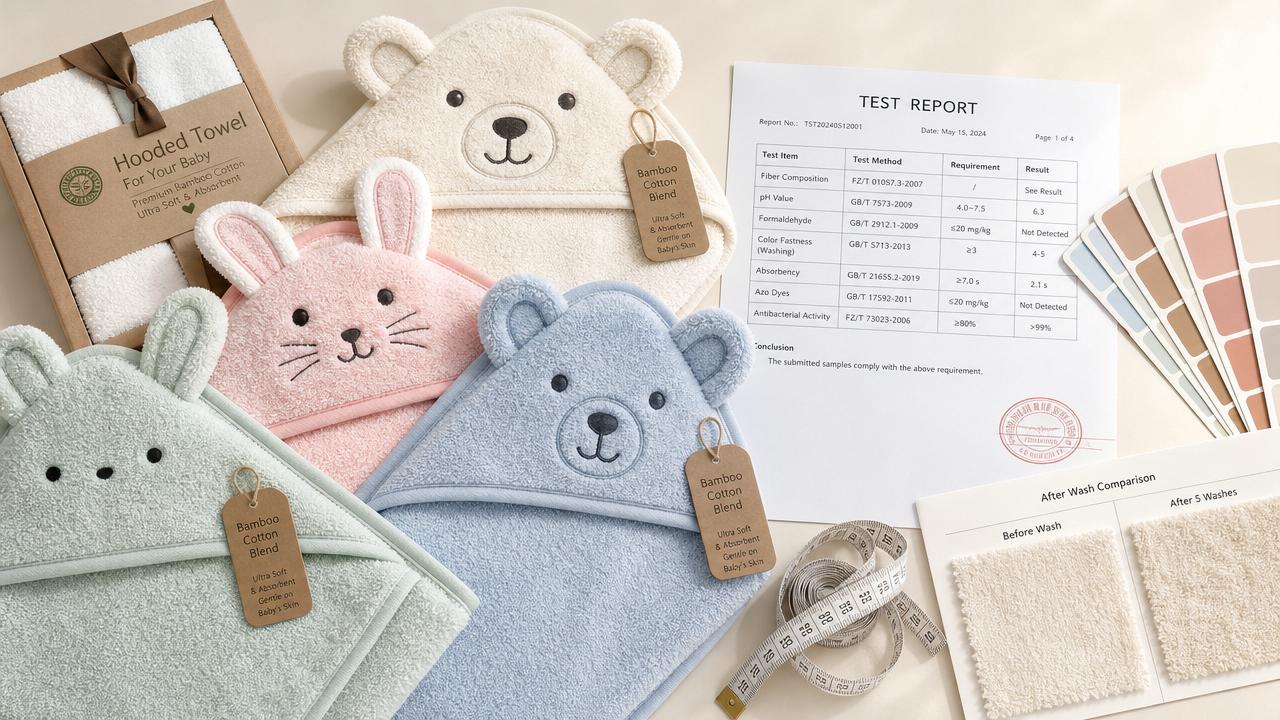
When sourcing wholesale baby hooded towels, quality comparison goes far beyond softness or price.
The real task is reducing product risk before it reaches the market.
That means checking fiber content, absorbency, seams, dyes, and compliance details with equal discipline.
For baby products, small defects can quickly become safety, complaint, or recall issues.
A structured review process helps buyers compare wholesale baby hooded towels more accurately.
It also makes supplier discussions clearer, faster, and easier to document.
Start With Material Composition, Not Surface Feel
Many wholesale baby hooded towels feel soft in a showroom sample.
But softness alone does not prove consistent quality or long-term performance.
Start by confirming the exact fiber blend.
Common options include 100% cotton, bamboo-cotton blends, and polyester blends.
For baby use, cotton usually remains the baseline choice because it is breathable and familiar to the market.
Bamboo blends may improve hand feel, but claims should be verified carefully.
Polyester content can improve cost control, yet it may reduce absorbency and change skin comfort.
Ask suppliers for fiber test reports, not just product descriptions.
In actual sourcing, labeling inconsistencies often begin at the material level.
- Confirm declared fiber percentage against lab results.
- Check whether the hood lining uses the same fabric.
- Review GSM because low weight can affect absorbency.
- Verify whether trims introduce non-baby-safe materials.
This first step already separates serious suppliers from purely price-driven offers.
Measure Absorbency and Drying Balance
Absorbency is central when comparing wholesale baby hooded towels.
A towel that feels plush but absorbs slowly may disappoint end users.
At the same time, extremely thick fabric can stay damp too long.
That creates hygiene concerns in humid storage or repeated household use.
A practical comparison should look at both water absorption and drying speed.
Request pre-wash and post-wash samples if possible.
Some wholesale baby hooded towels perform well before washing, then flatten or stiffen later.
That is a clear warning sign for long-term consumer satisfaction.
- Test water uptake time on the towel body and hood area.
- Compare thickness against drying time after controlled washing.
- Check whether the pile collapses after repeated laundering.
- Review shrinkage because absorbency can change with size distortion.
A balanced towel dries the baby efficiently and remains practical for daily care.
Check Stitching Strength and Structural Durability
Durability problems in wholesale baby hooded towels often appear at the seams first.
The hood attachment, edge binding, and decorative corners deserve close attention.
Loose threads may seem minor, but they often reflect weak process control.
For baby items, thread loops and detached trims can also raise safety concerns.
Look beyond appearance and ask how the product handles wash cycles and pulling force.
If embroidery or animal ears are included, inspect reinforcement methods carefully.
Decorative design can improve retail appeal, yet it can also introduce failure points.
Good structure is not only about appearance.
It protects product reputation, lowers claims, and supports repeat orders.
Review Colorfastness, Odor, and Chemical Safety
Chemical safety is one of the most critical areas in wholesale baby hooded towels.
A bright color or cute print should never come before safety compliance.
Start with colorfastness to washing, rubbing, and saliva-related contact conditions when relevant.
Dye bleeding can affect both appearance and user trust.
Strong odor is another simple but useful warning signal.
It may suggest finishing residues, poor storage, or uncontrolled chemical treatment.
Depending on the destination market, suppliers may need evidence for OEKO-TEX, REACH, CPSIA, or other local requirements.
The exact standard depends on where the wholesale baby hooded towels will be sold.
- Request recent test reports tied to the same production batch.
- Check whether reports cover fabric, print, and accessories.
- Confirm the lab name, date, and sample description.
- Verify that compliance claims match the target export market.
This is where a low-cost quote can become expensive very quickly.
Compare Packaging, Labeling, and Traceability
Quality evaluation should not stop at the towel itself.
Packaging and labeling often reveal how disciplined a supplier really is.
For wholesale baby hooded towels, labels should be clear, durable, and legally accurate.
That includes fiber content, care instructions, country of origin, and age-related warnings if required.
Barcode accuracy and carton marking matter too, especially for larger distribution systems.
Traceability becomes even more important when dealing with multiple colors, SKUs, or seasonal promotions.
If one issue appears, buyers need to identify affected lots quickly.
- Review retail label accuracy and wash durability.
- Check whether lot codes connect to raw material and production records.
- Inspect inner and outer packaging for contamination risk.
- Confirm carton consistency for warehouse handling and shipment counting.
A supplier with strong traceability usually performs better under pressure.
Evaluate Supplier Reliability Alongside Product Quality
Even good wholesale baby hooded towels can become a poor sourcing decision if the supplier is unstable.
That is why product comparison should be linked with factory capability review.
Ask how quality is controlled from fabric arrival to final packing.
Check whether inspection records are standardized and whether defects are classified clearly.
It also helps to understand subcontracting practices.
If embroidery, dyeing, or packaging is outsourced, risk points increase.
Lead time reliability matters as much as product consistency.
Late shipment on a baby textile program can disrupt retail windows and inventory planning.
- Review incoming material inspection records.
- Ask for defect photos from recent production lots.
- Confirm corrective action procedures for failed tests.
- Assess communication speed during sampling and revisions.
In real business settings, process transparency often predicts future performance better than polished sales language.
Build a Practical Comparison Matrix Before Ordering
A side-by-side matrix makes wholesale baby hooded towels easier to compare objectively.
Without one, buyers may overweight price or appearance.
Use weighted criteria based on actual risk exposure and market requirements.
For example, compliance and absorbency may deserve more weight than packaging design.
This approach turns sample review into a repeatable sourcing method.
It also helps internal teams align faster when making final decisions.
Final Takeaway
Comparing wholesale baby hooded towels is really about managing product, compliance, and supplier risk together.
The strongest option is not always the cheapest sample or the softest first impression.
A better decision comes from verifying materials, testing performance, checking construction, and reviewing safety evidence carefully.
When that product review is matched with supplier traceability and process discipline, sourcing becomes far more reliable.
Before placing the next order, build a clear checklist, compare samples under the same conditions, and require proof behind every key claim.
That simple discipline can make wholesale baby hooded towels easier to evaluate and much safer to buy at scale.
Related Intelligence