
What Should You Do If Metal Recycling Quality Fails Inspection?
A failed quality inspection in metal recycling is not just a laboratory problem. It can stop a shipment at the gate, trigger a price downgrade, force reprocessing, delay a furnace schedule, or create an argument over who absorbs freight and handling costs. In cross-border transactions, it may also expose weak documentation, inconsistent sampling, or a mismatch between the commercial contract and the receiving country's import requirements.
The first priority is to prevent a quality dispute from becoming a value-loss dispute. That means isolating the affected material, confirming the inspection basis, and responding with evidence rather than assumptions. A buyer may describe a load as “contaminated” or “off-grade,” but those findings can have very different causes and remedies. Mixed alloys, excess moisture, prohibited attachments, poor sorting, inaccurate labeling, and an unrepresentative sample all require different actions.
For recyclers, traders, processors, and procurement teams, the central question is not simply whether the lot failed. It is whether the failure reflects a correctable handling issue, a sorting-system weakness, an upstream supply problem, or a commercial specification that was never precise enough to manage in the first place.
Contain the lot before discussing responsibility
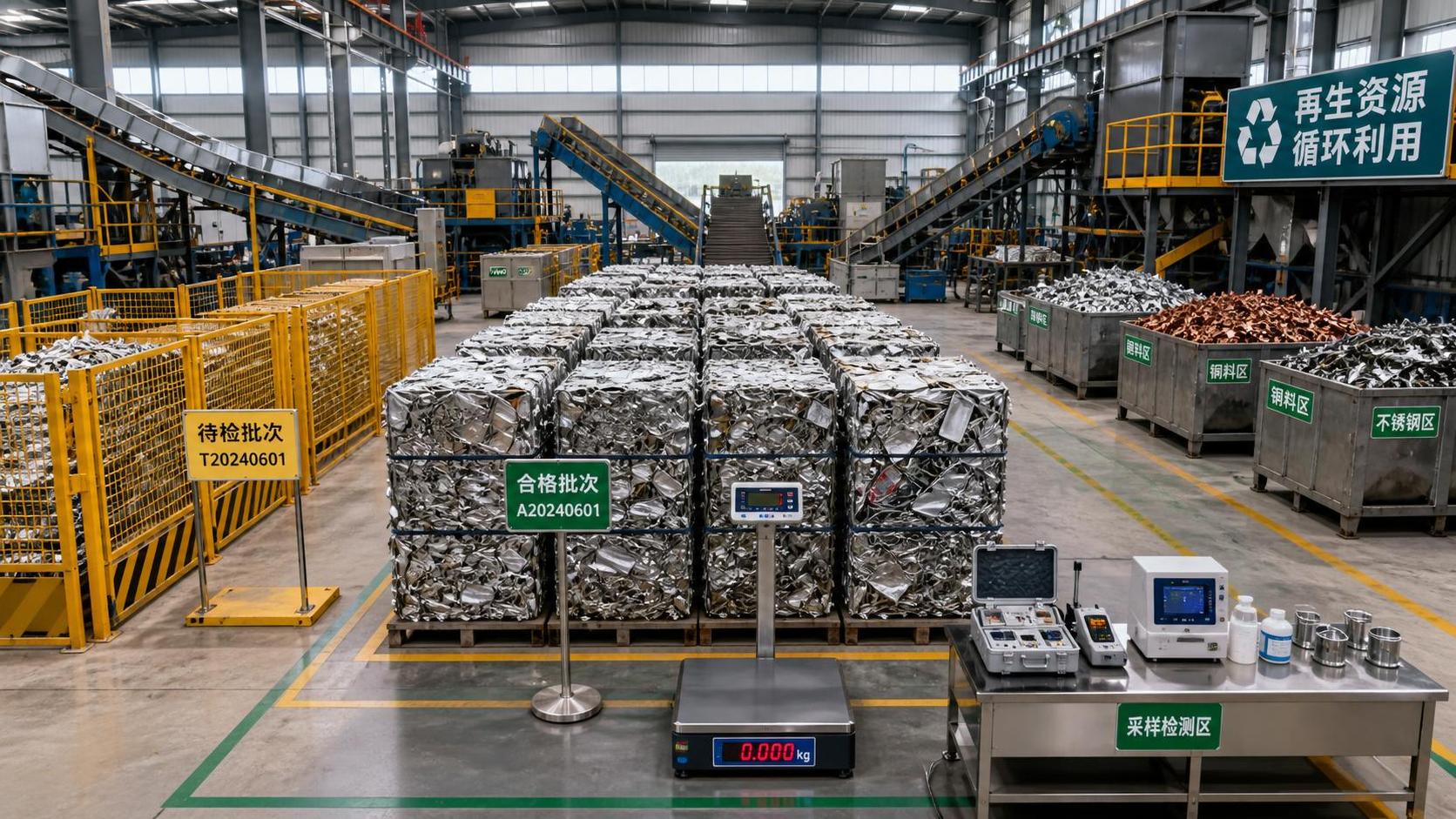
Once a load fails inspection, stop it from entering normal production or being blended into compliant inventory. Segregate the lot physically and digitally. Record the container number, vehicle number, bale or bundle references, weight ticket, supplier batch, arrival time, and photographs of the material condition as received. If the material is already unloaded, preserve the receiving area and avoid moving it repeatedly before joint inspection.
This step is operationally basic, but it matters because metal scrap can change condition quickly. Loose material can be mixed accidentally with other lots. Wet scrap may dry during storage, affecting later moisture readings. A load with visible non-metal attachments can be partially cleaned before evidence is documented. Once that happens, it becomes harder to determine whether the problem existed at origin, arose during transport, or resulted from receiving-site handling.
Assign a clear status in the inventory system: quarantined, pending resampling, pending rework, rejected, or accepted with adjustment. Do not allow a vague “hold” status to remain for days without an owner. The longer a disputed batch sits unaddressed, the more likely it is to create demurrage, storage congestion, production uncertainty, and a strained supplier relationship.
At the same time, review the purchase order, contract, material specification, inspection clause, and any agreed sampling protocol. A rejection is only as strong as the standard against which it is made. If the agreement says “clean aluminum scrap” but does not define alloy range, moisture limit, coating tolerance, non-metal content, sample method, or settlement mechanism, both parties may have reasonable but incompatible expectations.
Confirm what actually failed
Inspection reports often use broad language, while corrective action depends on a more specific diagnosis. Ask for the underlying measurements, photographs, test records, and sampling notes. Separate observable issues from analytical issues.
- Contamination: plastics, rubber, wood, fabric, insulation, dirt, glass, electronic components, sealed containers, or other foreign materials.
- Metallic mix: the presence of undesired ferrous, non-ferrous, or alloy materials in a grade intended to be more homogeneous.
- Grade mismatch: material is broadly recyclable but does not meet the agreed scrap category, alloy chemistry, size range, or form.
- Moisture or trapped liquids: water, oil, coolant, sludge, snow, or liquid retained in cavities and compressed packages.
- Safety or prohibited material: batteries, pressurized cylinders, radioactive sources, hazardous residues, medical waste, or closed containers.
- Documentation failure: incomplete packing list, incorrect grade declaration, missing origin records, inconsistent weights, or noncompliant customs or environmental documents.
It is useful to distinguish between a commercial quality failure and a safety or compliance failure. A modest level of recoverable non-metal content may be resolved through a rework charge or price adjustment. A prohibited item, suspected hazardous residue, or import restriction can require a much more formal response, including notification to authorities, insurers, carriers, or waste-management specialists. Treating these cases as ordinary grade disputes can create unnecessary legal and operational exposure.
Resampling is often appropriate, but only if the method is credible. A single surface grab from a container or one hand-picked sample from a bale may not represent the entire shipment. Mixed scrap is inherently variable. The parties should document where samples were taken, how many increments were collected, how the sample was prepared, and whether retained samples are available for independent review. For high-value alloy scrap, chemistry verification may need to be performed on a statistically meaningful selection rather than on one visually unusual piece.
Decide whether the material can be recovered
Not every failed load should be rejected. The commercially sound option depends on the material's recoverable value, processing cost, transport status, buyer capacity, and the contract's remedies. The practical choices generally fall into four paths: rework, regrade, price settlement, or return/rejection.
Rework makes sense when the defect is localized and the buyer has equipment or labor that can recover material efficiently. A processor receiving insulated copper cable, for example, may be able to remove nonconforming attachments and recover usable copper-bearing feedstock. The same approach may be uneconomic for a buyer expecting furnace-ready aluminum grades with tight chemistry requirements. Recovery capacity is not interchangeable across the supply chain.
Regrading can be more realistic than attempting to restore the original specification. A load sold as a relatively clean, segregated grade may still have value in a lower-grade application, but the commercial impact can be significant. The supplier should not assume that the buyer can simply “use it elsewhere.” Different downstream outlets have different furnace constraints, yield expectations, residual-element limits, and environmental controls.
A price adjustment is appropriate only when the defect is measurable and the buyer can still use the material safely and predictably. The settlement should state the accepted net weight, deduction basis, processing charge where applicable, revised grade, and final payment timing. Broad discounts without a documented calculation may solve one dispute while encouraging repeated quality drift in future shipments.
Find the root cause beyond the rejected shipment
The failed lot is evidence of a process weakness somewhere in the chain. The most useful investigation follows the material backward: collection point, consolidation yard, sorting line, storage area, loading process, transport, and receiving inspection. Avoid beginning with blame. The goal is to identify where controls stopped working.
For a recycler, common upstream causes include inconsistent feedstock from demolition, end-of-life vehicles, mixed industrial turnings, or collection networks that pay suppliers primarily by weight. Weight-based incentives can unintentionally reward wet, contaminated, or poorly sorted material. A processor may also find that a new supplier, shift team, or subcontracted yard was introduced without the same acceptance standards used for established sources.
At the yard level, failures frequently originate in weak segregation. Shared bins, unclear signage, damaged labels, and crowded storage areas make grade mixing more likely. Material classification based only on visual judgment can be insufficient for alloys that look similar but behave differently in remelting. Portable analyzers, magnetic separation, eddy-current systems, density separation, and optical sorting may help, but technology should match the risk and value of the material stream. Installing advanced equipment does not compensate for poor feedstock discipline or inadequate operator training.
Loading practices deserve equal scrutiny. Material that meets specification when packed can fail after shipment if it is exposed to rain, mixed with loose residues from the loading floor, compressed with incompatible scrap, or placed in containers that previously carried contaminating materials. Photos taken before sealing, seal records, container cleanliness checks, and loading checklists are modest controls that become valuable when a dispute arises.
For turnings and borings, moisture and residual fluids need particular attention. Their value depends not only on metal content but also on the cost of removing coolant, cutting oil, and fines. A visible moisture issue may be the symptom of inadequate centrifuging, drainage time, covered storage, or container design. It should not automatically be treated as fraud, but it should be measured against a written acceptance rule.
Do not confuse inspection failure with supplier failure
A rejected shipment does not always mean the supplier is unreliable. It may indicate that the buyer's specification is too broad, the inspection procedure is inconsistent, or the material is being purchased for an application with tighter requirements than the sourcing team communicated. These distinctions matter because recycling supply chains depend on repeat flows, not one-off transactions.
One common misunderstanding is that a named scrap grade guarantees uniform composition. In practice, named grades provide a commercial framework, but actual quality still varies with source material, preparation method, geography, and handling. Buyers needing tight alloy control should state the required chemistry or accepted alloy families, not rely solely on a general grade name. Similarly, a “dry” requirement should define how moisture is assessed and whether rain exposure, surface water, or retained process fluid are included.
Another weak assumption is that a certificate or supplier declaration resolves all risk. Documentation supports traceability, but it does not replace receiving inspection. A declaration may be accurate when issued and still fail to reflect a later loading error, substitution, or transport issue. Conversely, a failed document review does not prove the physical material is unacceptable; it may be a correctable administrative gap. Physical quality controls and documentation controls should reinforce each other.
Third-party inspection can help where cargo value, distance, or dispute history justifies the cost. However, it is most effective when the parties agree in advance on scope, sampling method, test criteria, and which result is binding. Calling an inspector only after a disagreement has hardened can clarify facts, but it may not resolve the commercial interpretation of those facts.
Build a more reliable inspection-to-settlement process
The strongest corrective action is a process that makes future failures easier to prevent and easier to settle. This does not need to be an elaborate quality-management program for every supplier. It should be proportionate to material risk, shipment frequency, and downstream sensitivity.
Start by converting vague descriptions into measurable acceptance criteria. For each purchased material, define the intended grade, acceptable source types, prohibited materials, contamination tolerance where applicable, moisture basis, size or density requirements, sampling approach, and remedy for nonconformance. State whether the buyer may rework the material and charge costs, whether a discount formula applies, and under what conditions a shipment may be rejected outright.
Then connect those requirements to the supplier's actual operating conditions. A small collector handling mixed demolition scrap cannot reliably supply the same consistency as a specialized processor operating dedicated separation lines. That does not automatically make the supplier unsuitable. It means the buyer should match the supply source to the application, pricing model, and inspection intensity. High-spec secondary metal feedstock usually requires more control at origin and more transparency across handling steps.
Digital traceability can improve this process when it records information that people actually use: supplier batch, photographs, inspection result, test data, corrective action, final settlement, and recurrence by defect type. A simple dashboard showing contamination failures by supplier, facility, material grade, and season may reveal patterns that isolated inspection reports miss. For example, recurring wet shipments may correlate with uncovered staging areas or specific transport lanes, while alloy mix-ups may be concentrated in a particular sorting shift.
Quality data should also feed procurement decisions. A supplier with a slightly higher unit price may produce better delivered value if its material requires less rework, produces more usable yield, and creates fewer line disruptions. The purchase price per tonne is only one part of the cost. Internal sorting, testing, disposal, downtime, claims administration, and working-capital delays can materially change the real economics of a recycled-metal purchase.
Use the incident to reset commercial discipline
When metal recycling quality fails inspection, the right response is neither automatic rejection nor automatic compromise. Secure the lot, validate the evidence, classify the risk, and choose the disposition that best protects safety, compliance, and recoverable value. Then use the result to improve specifications, source controls, inspection methods, and settlement rules.
As secondary metals become more important to manufacturing supply chains, buyers will face greater pressure to balance circularity targets with production consistency. That makes quality control a commercial capability, not merely a receiving-department task. The companies that handle failed inspections well are usually the ones that can explain exactly what went wrong, what the material is still worth, and what must change before the next shipment arrives.
Related Intelligence