
What Are the Risks of Skipping Preventive Maintenance on Switchgear?
A production line has been running without obvious electrical trouble for months. The switchgear doors stay closed, the indicators look normal, and there is always another urgent task competing for maintenance time. Then a motor feeder begins tripping during a busy shift, or a main breaker refuses to close after a planned shutdown. In a worse situation, heat damage, insulation breakdown, or an internal arc event turns a manageable maintenance task into an emergency.
That is the practical answer behind the question, What are the risks of skipping preventive maintenance on switchgear? The risk is not simply that a component may wear out. Switchgear sits at the point where electrical faults can spread into equipment damage, safety exposure, unplanned downtime, missed deliveries, and difficult recovery decisions. Many problems develop quietly: loose connections heat gradually, moisture weakens insulation, mechanisms lose lubrication, and protective devices drift away from their intended settings.
Preventive maintenance is the disciplined process of finding those conditions before the power system is asked to perform under stress. It does not eliminate every failure, but it gives maintenance teams a chance to correct known weaknesses during a planned outage rather than during a production interruption.
The moment “it still works” becomes a risky maintenance strategy
Skipping maintenance often begins with a reasonable concern. Taking a distribution board or motor control section offline can affect output. Spare parts may not be immediately available. A site may also believe that newer switchgear needs little attention because it has not shown alarms or visible damage.
The problem is that switchgear condition cannot be judged reliably from its exterior alone. A breaker may close and trip normally during simple operation while its contacts are worn, its operating mechanism is slow, or its protection circuit has an issue that only appears during a fault. Likewise, a busbar connection can look intact but develop excessive resistance due to poor torque, oxidation, vibration, or thermal cycling.
In industrial environments, switchgear is exposed to more than electrical load. Dust, conductive contamination, humidity, corrosive atmosphere, insects, vibration, high ambient temperature, and repeated switching cycles all affect condition. Even facilities with clean rooms or enclosed electrical spaces must account for aging insulation, component fatigue, and changes in load patterns.
A useful way to frame the decision is this: planned maintenance creates a controlled interruption; deferred maintenance can create an uncontrolled event with uncertain scope.
Risks that build up behind closed panels
Unexpected outages and difficult fault isolation
The most visible consequence is loss of continuity. A neglected circuit breaker, contactor, relay, fuse holder, cable termination, or control-power component can fail without much warning. When this happens, the immediate task is not just replacing the failed item. The team must determine whether the failure was isolated or whether it damaged adjacent equipment, affected upstream protection, or revealed a broader system issue.
Fault isolation during an unplanned outage is slower and more stressful than a planned inspection. Documentation may be incomplete, the original configuration may have changed, and personnel may need to work around production, safety restrictions, or unavailable spare components. If a critical feeder serves pumps, compressors, process controls, refrigeration, material handling, or safety-related systems, a local electrical defect can quickly affect wider operations.
Arc-flash and shock exposure
Switchgear is designed to contain and control electrical energy, but degraded components raise the likelihood of abnormal conditions. Loose or contaminated connections can create localized heating and arcing. Worn insulation can reduce clearance performance. Faulty interlocks, damaged barriers, or poorly maintained breaker mechanisms can increase exposure during operation and troubleshooting.
Arc-flash risk assessment is not a one-time paperwork exercise. The available fault energy, clearing time, protective-device performance, equipment condition, and system configuration all matter. If protective relays or trip units are not tested, a fault may take longer to clear than the system design assumes. That can increase damage and the hazard faced by qualified workers.
Routine maintenance should therefore include both physical condition checks and verification that the protective system responds as intended. Safety depends on more than warning labels and personal protective equipment; it also depends on equipment that operates correctly when a fault occurs.
Heat damage that spreads beyond one connection
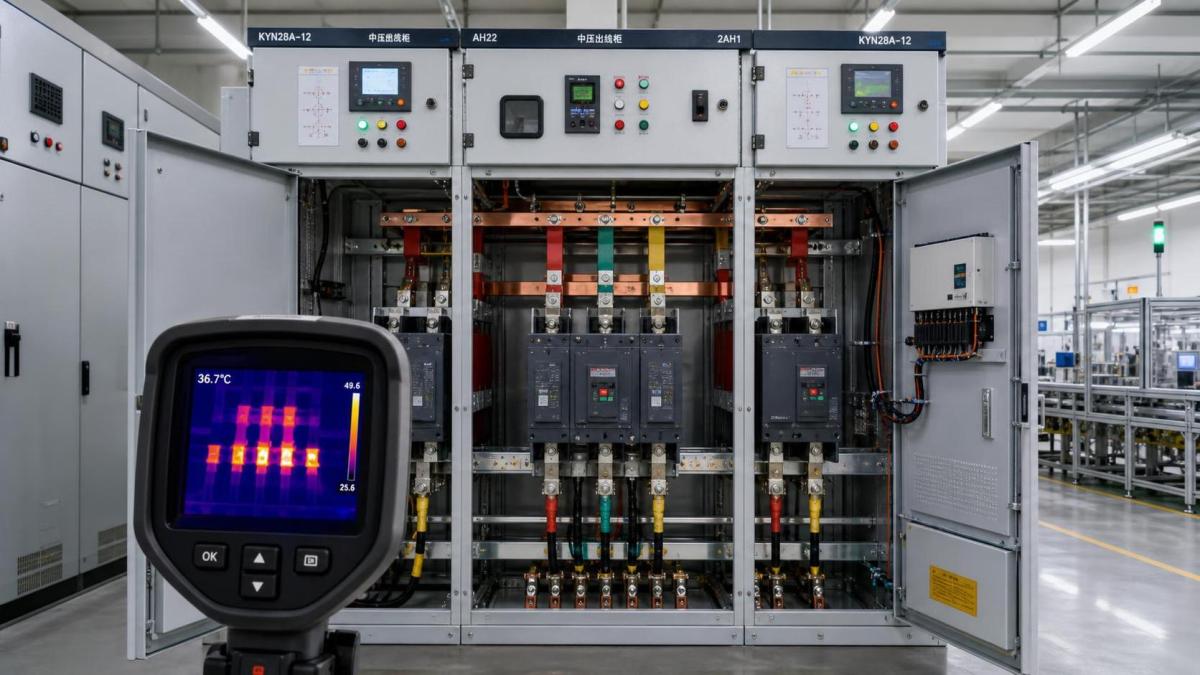
Overheating is one of the most common hidden switchgear problems. It may begin at a single bolted joint, cable lug, breaker contact, or bus connection. Resistance rises slightly, temperature increases under load, and repeated heating cycles worsen the connection. Eventually, insulation may discolor, terminals may lose tension, and nearby materials can deteriorate.
Heat damage can be especially deceptive because the equipment may operate normally at low load. The weakness becomes obvious only when production demand rises, ambient temperature increases, or multiple loads start at once. By then, the affected part may require replacement rather than adjustment.
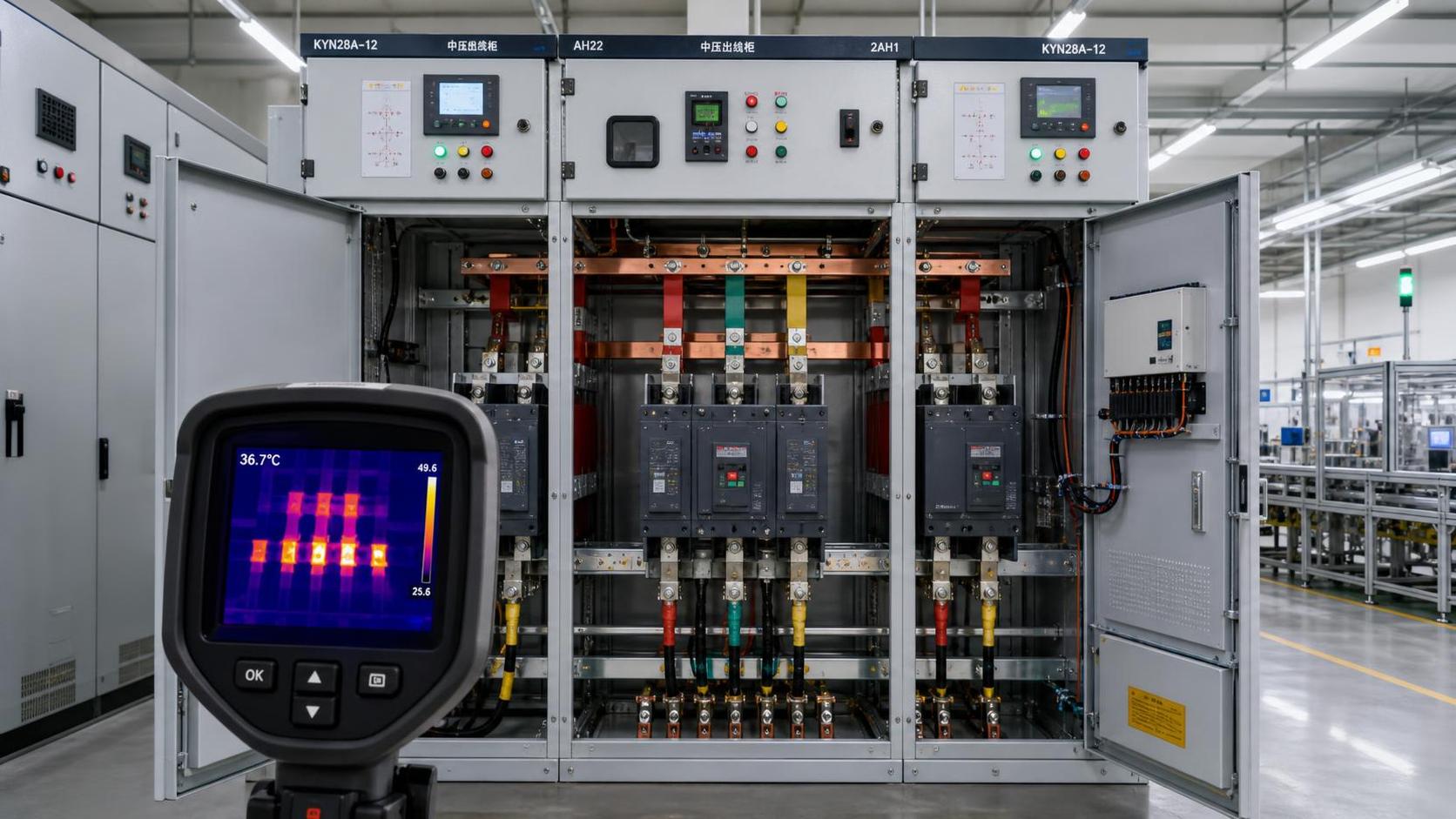
Infrared thermography can help identify abnormal temperature patterns while equipment is energized, but the findings must be interpreted in context. Load level, emissivity, viewing angle, enclosure design, and comparison with similar phases or feeders all affect the result. A thermal scan is valuable, yet it does not replace de-energized inspection, torque verification where appropriate, or functional testing.
Protection that no longer matches the real system
Electrical systems rarely remain unchanged. New machines are added, motors are replaced, transformers are upgraded, backup generation is connected, or operating sequences are altered. These changes can affect fault current, coordination, load profiles, and protective settings.
If switchgear maintenance is skipped, protection settings and trip functions may also be left unreviewed. A breaker could trip too quickly and stop healthy downstream equipment, or it could fail to isolate a fault selectively. In either case, personnel lose confidence in the system and may be tempted to bypass protective functions to keep operations moving. That response creates a larger safety issue.
Any modification to the distribution system should trigger a review by competent electrical personnel. The review should compare updated one-line diagrams, equipment ratings, protection settings, and actual installation conditions. Preventive maintenance provides a practical opportunity to catch mismatches before they become part of normal operation.
Higher repair costs and longer recovery time
A minor issue found during a scheduled shutdown may involve cleaning, tightening, lubrication, calibration, or replacement of a worn auxiliary part. The same issue left unattended can damage a breaker compartment, bus assembly, cable insulation, control wiring, or connected load.
Emergency repairs also create procurement pressure. The required breaker frame, trip unit, relay, contact kit, or molded component may not be available from local stock. Older equipment may have discontinued parts or limited interchangeability. Without an accurate equipment inventory and critical-spares plan, a small failure can turn into an extended wait for compatible components and technical confirmation.
Warning signs worth taking seriously
Not every indication means imminent failure, but recurring or unexplained symptoms deserve investigation. Maintenance teams often first notice these conditions during routine rounds, shift handovers, or after a nuisance trip:
- A breaker feels unusually warm, has discoloration near terminals, or produces a persistent odor.
- Trips occur after load changes even though the process equipment appears normal.
- Operators hear buzzing, crackling, rattling, or delayed mechanical action during switching.
- Panel doors are difficult to close, interlocks do not operate smoothly, or breaker racking feels abnormal.
- Dust, moisture marks, corrosion, pest debris, or loose hardware appears inside an enclosure.
- Protective relay alarms, control-power issues, or communication faults are being reset repeatedly without finding the cause.
- Electrical drawings, circuit labels, and breaker settings no longer agree with the installed system.
A common mistake is treating these signs as separate inconveniences. In reality, they may point to aging equipment, poor environmental control, overloaded circuits, incomplete previous work, or a system that has changed without proper review.
A practical route back to control
When preventive maintenance has been postponed, the first step is not to open every enclosure immediately. Start by understanding what is installed and which sections carry the greatest operational consequence. A simple asset register should identify switchgear location, manufacturer and model, voltage class, feeder purpose, protective device type, maintenance history, known defects, available drawings, and spare-part status.
Then prioritize based on consequence and condition. Main incoming sections, critical process feeders, equipment with repeated trips, panels in hot or corrosive areas, and older units with limited spare availability generally deserve earlier attention. This is more useful than applying the same maintenance interval to every panel regardless of duty.
Prepare the maintenance window carefully
Before de-energized work begins, define the scope, isolation boundaries, lockout/tagout steps, permits, arc-flash precautions, test instruments, replacement materials, and acceptance criteria. Confirm who can authorize switching and who will communicate with production or facility operations.
Review the latest one-line diagram and compare it with field labels. If the documentation is uncertain, resolve that before switching. Incorrect assumptions about backfeeds, generator connections, capacitor banks, photovoltaic sources, or inter-ties can create serious hazards.
Inspect, clean, test, and document
The exact tasks depend on equipment type and the manufacturer’s instructions, but a sound maintenance visit usually combines several methods. Visual inspection looks for contamination, damaged insulation, corrosion, loose hardware, overheating evidence, missing barriers, and improper modifications. Mechanical checks assess breaker operation, racking mechanisms, shutters, interlocks, springs, and door hardware.
Electrical testing may include insulation resistance testing, contact resistance testing, breaker timing tests, relay or trip-unit functional checks, and verification of control circuits. Torque work should follow approved values and procedures rather than assumptions. Cleaning must use methods suitable for the equipment and contamination involved; compressed air used carelessly can drive debris deeper into sensitive areas.
Each finding should be recorded with its location, observed condition, recommended action, urgency, and any temporary restriction. Clear records matter because a maintenance program is not just a day of work. It is the basis for tracking recurring defects, planning outages, managing spares, and deciding when repair is no longer economical.
Deciding whether to repair, refurbish, or replace
Not every older switchgear assembly needs immediate replacement. Some can remain dependable when the enclosure, bus system, insulation, and protective functions are in acceptable condition and supported components are available. Others may need targeted refurbishment, such as replacing worn breakers, upgrading trip units where technically appropriate, renewing control wiring, or correcting environmental problems.
Replacement becomes more compelling when equipment has repeated failures, cannot be safely serviced, lacks compatible parts, has significant insulation or bus damage, or no longer suits the fault duty and operating needs of the system. The decision should consider downtime planning, available space, cable arrangements, protection coordination, and commissioning requirements, not only the purchase cost of a new lineup.
For complex sites, involve qualified electrical engineers and service personnel early. They can help determine whether observed defects are local maintenance issues or signs that the system’s design assumptions need to be revisited.
Keeping maintenance from being postponed again
The most reliable programs are tied to operations rather than treated as an optional annual event. Coordinate maintenance windows with production schedules, planned turnarounds, low-demand periods, and equipment changeovers. Keep a rolling list of defects that cannot be corrected immediately, and make sure temporary measures have an owner and a due date.
It also helps to separate routine operator observations from qualified electrical maintenance tasks. Operators can report unusual heat, noise, odors, indicator changes, and repeated trips. Qualified personnel should perform switching, internal inspection, testing, settings review, and corrective work according to site procedures and equipment instructions.
Skipping preventive maintenance on switchgear may seem like a way to avoid disruption, but it often shifts disruption into a more expensive and less controllable form. A condition-based, documented program gives teams time to find faults early, protect workers, preserve critical equipment, and make repair or replacement decisions before a power-system problem dictates the schedule.
Related Intelligence