
Does My Distribution Room Need Arc-Resistant Switchgear?
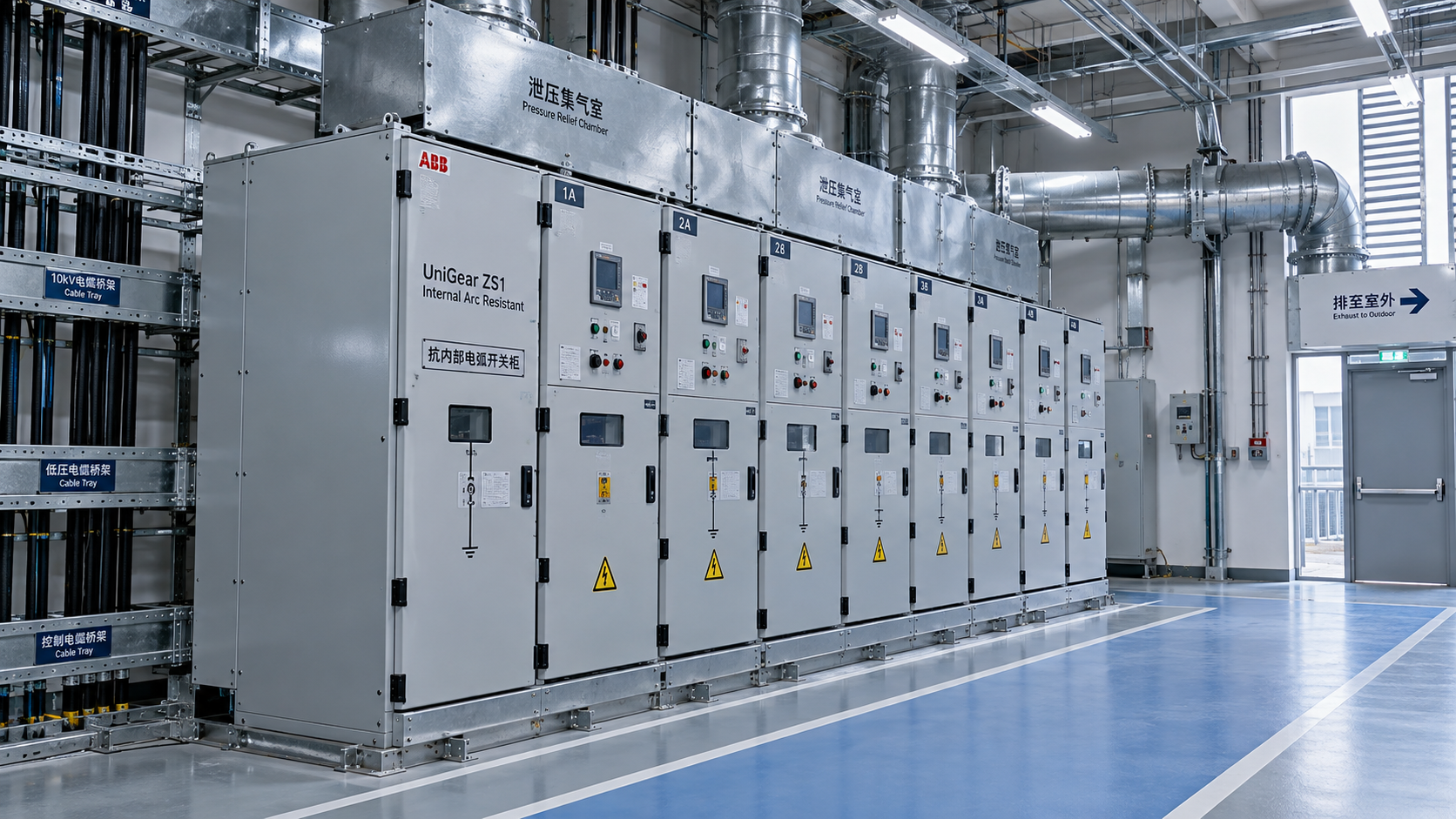
“Do I need arc-resistant switchgear for my distribution room?” For factory managers, facility engineers, and procurement teams, the answer depends on more than equipment price. Available fault current, protective-device clearing times, worker exposure, room layout, and applicable requirements all shape the decision.
Arc-resistant switchgear deserves serious consideration where people may be exposed to an internal arcing fault, but it is not automatically required in every distribution room. It can redirect pressure and hot gases under specified test and installation conditions. It does not replace an arc-flash risk assessment, proper maintenance, or safe work practices.
The useful question is not simply whether to buy a stronger enclosure. It is whether the complete installation—including protection, operating procedures, and exhaust arrangements—provides an appropriate level of protection for the people using the room.
What does “arc-resistant” actually mean?
An internal arcing fault can release intense heat, pressure, molten material, and hot gases. It may result from insulation failure, contamination, loose connections, equipment deterioration, or an error during maintenance. Conventional metal-enclosed equipment is not necessarily designed or tested to manage these effects for personnel protection.
Arc-resistant switchgear incorporates features such as reinforced enclosures, secured doors, pressure-relief arrangements, and exhaust plenums or ducts. These features are tested to evaluate protection at designated accessible locations under defined internal-arcing conditions.
The designation is conditional, not a promise that the equipment is “arc-proof.” Performance depends on the tested configuration, fault current and duration, door positions, covers, installation clearances, and exhaust arrangements. An installation that differs from the tested design may not provide the intended protection.
IEEE C37.20.7 is a relevant guide for internal-arcing tests of covered switchgear designs. For medium-voltage equipment in IEC-based markets, IEC 62271-200 includes internal arc classification provisions. The classifications are not interchangeable; buyers should specify the applicable standard and required accessibility conditions rather than accept a generic “arc-resistant” claim.
Is arc-resistant switchgear legally required in a distribution room?
There is no universal rule that every distribution room must contain arc-resistant switchgear. Requirements depend on jurisdiction, installation type, adopted codes, owner specifications, utility conditions, and sometimes insurer expectations.
In the United States, OSHA electrical safety requirements, adopted electrical codes, and workplace practices addressed by NFPA 70E influence how hazards must be managed. They should not be interpreted as a blanket requirement to replace every conventional switchgear lineup with an arc-resistant design.
Elsewhere, national rules and project specifications may refer to IEC standards or impose internal-arc requirements for particular facilities. A utility substation, public infrastructure project, and private factory may have different acceptance criteria.
Before requesting quotations, ask your electrical engineer to identify:
- The codes and standards applicable to the installation.
- Any owner, utility, insurer, or contractual requirements.
- The required equipment classification and personnel-access conditions.
- The documentation needed for inspection and project acceptance.
This avoids two expensive mistakes: purchasing protection the project cannot accommodate, or discovering mandatory requirements after the equipment order has been placed.
What information determines whether my room needs it?
The decision should begin with the electrical system and operating routine, not the equipment brochure. A distribution room that appears quiet may still contain substantial electrical energy, particularly near a transformer or multiple power sources.
Do not use prospective short-circuit current alone as a proxy for arc-flash risk. Arcing current and protective-device behavior also matter. In some systems, a lower arcing current can take longer to clear because it falls below an instantaneous trip threshold.
A qualified engineer should evaluate credible operating configurations, including relevant utility, generator, and tie-breaker arrangements. Studies based on outdated drawings or assumed protection settings can lead to misleading purchasing decisions.
Will arc-resistant switchgear eliminate arc-flash PPE requirements?
No. Arc-resistant construction and arc-flash PPE address different parts of the hazard. The enclosure manages internal-fault effects under specified conditions; PPE selection and work controls depend on the task and risk assessment.
Arc-resistant performance commonly relies on designated doors and covers being closed and secured. Opening a power compartment for troubleshooting may remove the protection relevant to that task. Some designs provide tested protection with specified low-voltage control-compartment doors open, but this must be verified in the classification and manufacturer’s documentation.
Never assume an arc-resistant label authorizes energized work or eliminates PPE. Follow the applicable safety program, task assessment, and equipment instructions. Establishing an electrically safe work condition remains the preferred approach whenever feasible.
Likewise, a standard incident-energy calculation should not simply be reduced because an enclosure is described as arc-resistant. IEEE 1584 calculations are not a substitute for verifying an equipment assembly’s internal-arcing classification.
Can my existing distribution room accommodate the equipment?
This is often where an attractive specification meets a difficult building. Arc-resistant equipment may need additional space above the lineup, pressure-relief plenums, or ducts carrying gases to an approved discharge location.
A narrow room with a low ceiling, overhead cable trays, and an occupied corridor outside may require substantial redesign. A discharge arrangement cannot be selected solely because it is the shortest route through the wall.
The layout review should cover:
- Manufacturer-required clearances and ceiling conditions.
- Exhaust routing, permitted duct geometry, and discharge exclusion areas.
- Personnel access, escape routes, and maintenance working space.
- Structural support, cable entry, and pressure-related installation provisions.
- Interfaces with ventilation, fire protection, and building penetrations.
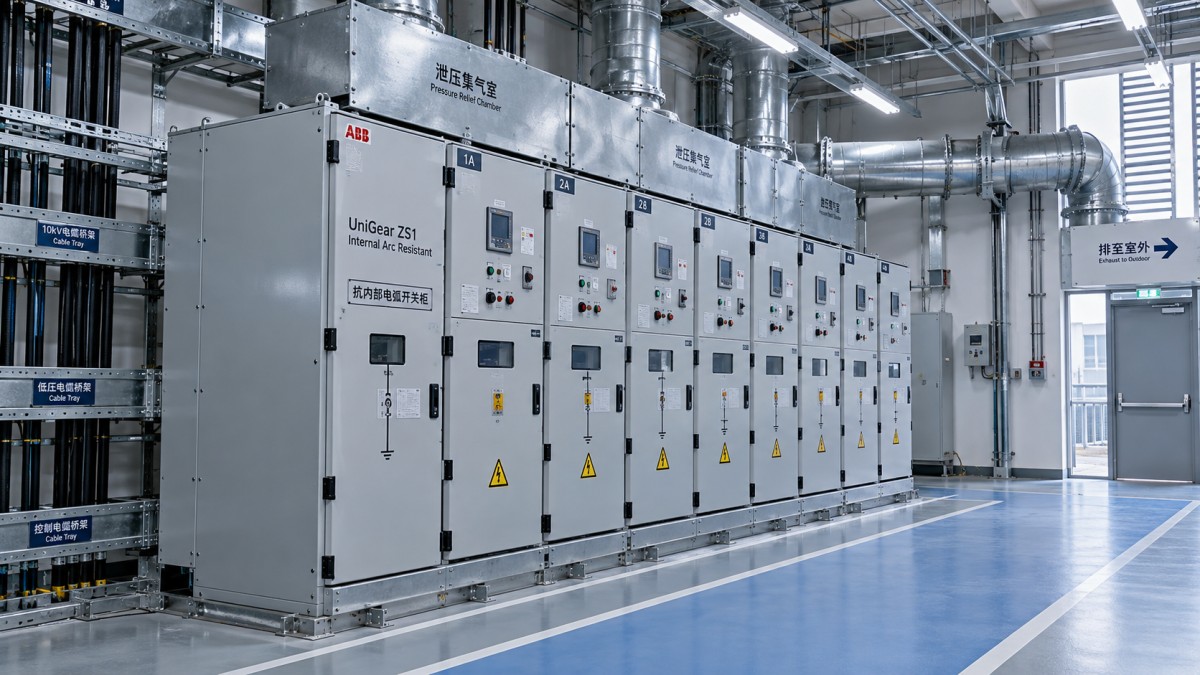
Some products use arrangements other than externally ducted exhaust, but their room requirements still need verification. “No external duct” does not mean “no installation constraints.”
For a retrofit, ask the supplier to review the actual room drawings before commercial approval. Include the required accessories and installation details in the purchase scope. A tested assembly and a locally improvised exhaust arrangement are not automatically equivalent.
How does it compare with faster protection and remote operation?
These measures are complementary rather than interchangeable. Each addresses a different part of the risk.
- Arc-resistant construction: helps manage the external effects of an internal fault within its tested conditions.
- Faster fault clearing: can reduce the duration of an event through suitable relays, differential protection, arc-detection systems, or other coordinated schemes.
- Remote switching or racking: can move personnel away from equipment during particular operations.
- Maintenance and condition monitoring: can help identify deterioration and reduce some causes of failure.
- De-energized work: removes electrical exposure when an electrically safe work condition is properly established.
Faster protection must be engineered carefully. A setting change intended to reduce arc-flash energy can affect selectivity or nuisance tripping. Remote operation reduces exposure during the tasks it supports, but it does not necessarily protect someone inspecting the lineup nearby.
In a facility with demanding production schedules, the best solution may combine several measures. Safety and operational continuity should be considered together, without treating production pressure as justification for avoidable energized work.
What should procurement teams ask suppliers?
A quotation saying “arc-resistant switchgear” is not sufficiently detailed for a technically sound purchase. Ask for evidence that the offered configuration matches the intended application.
- Which test standard and classification apply? Confirm protected sides, accessibility conditions, compartments, and any door-position limitations.
- What internal-arcing current and duration were tested? Check these against the engineering study and required clearing performance.
- What are the normal electrical ratings? Arc resistance does not replace verification of voltage, continuous current, interrupting capacity, and short-time withstand ratings.
- What installation conditions are mandatory? Obtain drawings showing clearances, plenums, ducts, and discharge restrictions.
- Does the evidence cover the offered configuration? Request applicable test documentation and confirmation of permitted variations.
- What preserves performance over time? Ask about inspections, replacement components, door hardware, pressure-relief devices, and restrictions on modifications.
For international sourcing, clarify who is responsible for local compliance and installation approval. A supplier’s experience in another market does not establish suitability for your site.
Is the additional cost justified?
Compare installed lifecycle cost, not just the switchgear purchase price. The budget may include room alterations, exhaust ducting, engineering studies, commissioning, outage work, training, and spare parts.
The operational benefit also needs realistic boundaries. Arc-resistant equipment may improve personnel protection under specified conditions, but it does not guarantee that the lineup will remain serviceable after an internal fault. Equipment replacement and production interruption may still be substantial.
The case is often stronger when personnel regularly operate equipment locally, the consequences of exposure are severe, or a new-build project can accommodate the required layout without major reconstruction.
Where exposure is limited and existing equipment remains suitable, an engineering review may instead prioritize protection upgrades, remote operation, maintenance, or revised work procedures. That conclusion should follow an assessment—not a preference for the lowest quotation.
What is the practical next step?
If you are asking, “Do I need arc-resistant switchgear for my distribution room?”, gather the single-line diagram, transformer and source data, protective-device settings, existing studies, room drawings, and typical operating tasks.
Have a qualified electrical engineer review those records against current site conditions. Then compare technically valid options, including arc-resistant equipment, faster protection, remote operation, and improvements to work practices.
Choose arc-resistant switchgear when its verified protection fits the risk, the installation supports its tested conditions, and the operating program preserves those conditions. The goal is not simply a better equipment label. It is a distribution room where purchasing decisions, engineering design, and daily work support the same safety outcome.
Related Intelligence