
Muslin Swaddle Blankets Wholesale: Quality Checks Before Ordering
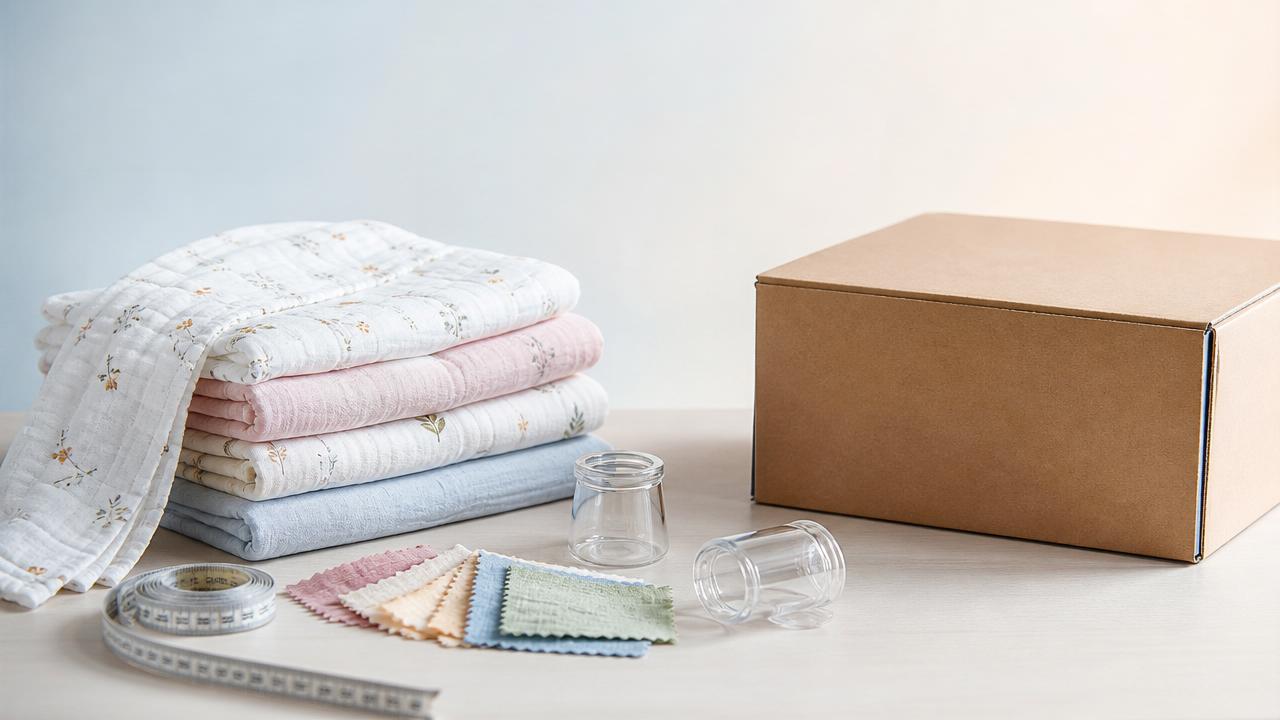
Before confirming a bulk order, muslin swaddle blankets wholesale should be reviewed through quality, safety, compliance, and supplier-control lenses.
A low unit price may look attractive, but infant textile products leave little room for weak inspection systems.
Fabric feel, shrinkage, labeling accuracy, chemical safety, and packaging integrity can all affect shipment acceptance and brand risk.
Why Muslin Swaddle Blanket Quality Matters in Global Sourcing
Muslin swaddle blankets are usually lightweight cotton or cotton-blend textiles used for newborn wrapping, nursing, stroller cover, or daily care.
The product looks simple, yet its quality depends on yarn selection, weaving density, finishing, sewing, printing, and packaging control.
For muslin swaddle blankets wholesale, small defects become larger commercial problems once thousands of units enter retail channels.
A fabric that shrinks excessively may change size claims. A weak seam may fail after washing. A poor dye may transfer color.
More importantly, products used around infants must meet stricter expectations than general home textiles.
This is why muslin swaddle blankets wholesale requires a structured quality checklist before purchase order confirmation.
The issue also connects with wider B2B supply chain practice: verified specifications, traceable production, and compliant export documentation.
Start With the Product Specification, Not the Quotation
A quotation only has meaning when the requested specification is clear and measurable.
For muslin swaddle blankets wholesale, the specification should define material, size, GSM, yarn count, weave, color, printing method, and packaging.
Without this baseline, supplier comparisons become unreliable. Two similar prices may represent very different fabric standards.
The purchase file should include tolerance ranges, not only target values.
For example, a 120 x 120 cm blanket may allow limited variation after cutting, sewing, and laundering.
GSM should also be checked across samples, because uneven fabric weight can indicate unstable weaving or finishing.
Fabric Performance Checks Before Bulk Production
The most visible quality issue in muslin swaddle blankets wholesale is fabric inconsistency.
Muslin is valued for softness and breathability, but loose construction also makes dimensional control more challenging.
Pre-production samples should be washed according to care instructions before approval.
This reveals shrinkage, twisting, fraying, color fading, and changes in hand feel after normal use.
A good inspection plan does not rely on touch alone.
Basic laboratory checks can include fabric weight, dimensional stability, pilling resistance, colorfastness to washing, and colorfastness to rubbing.
If the order includes darker prints, wet rubbing results deserve closer attention.
If the order includes white or pastel shades, contamination and yellowing should be reviewed during packing.
Shrinkage and Size Stability
Muslin fabric often tightens after washing, especially if finishing control is weak.
Before ordering muslin swaddle blankets wholesale, check both lengthwise and widthwise shrinkage after repeated laundering.
The test result should match the size claim printed on packaging or online listings.
Softness Without Unsafe Finishing
Softness is important, but it should not depend on questionable chemical softeners.
Request finishing details and, where necessary, third-party test reports for restricted substances.
A blanket should feel gentle while still meeting safety and compliance expectations.
Construction Details That Often Decide Acceptance
Sewing quality is easy to overlook because muslin blankets appear flat and uncomplicated.
In reality, edge finishing can decide whether the product survives washing and daily handling.
For muslin swaddle blankets wholesale, inspection should cover seam strength, stitch density, thread quality, loose threads, and skipped stitches.
Edges should be even, with no sharp labels, rough trims, or unsecured thread ends.
Labels and decorative elements need special caution.
Anything attached to an infant textile should be secure, soft, and consistent with the product’s intended use.
If hangtags, ribbons, or gift packaging are added, they should not create confusion with the actual use environment.
- Check stitch density against the approved sample, not only against a supplier’s internal standard.
- Confirm that care labels remain readable after washing and do not irritate the fabric edge.
- Inspect corners carefully, because fraying often begins where turning and stitching overlap.
- Review needle detection procedures if metal contamination control is required by the buyer.
Chemical Safety and Compliance Should Be Verified Early
Infant-related textile products face high sensitivity around chemical safety.
For muslin swaddle blankets wholesale, common testing areas include formaldehyde, azo dyes, heavy metals, phthalates, and pH value.
The exact requirements depend on destination market, claim type, age grading, and distribution channel.
Products sold into the United States, European Union, United Kingdom, Australia, or Canada may face different documentation expectations.
Retailers may also apply private standards that go beyond legal minimums.
Testing should be planned before bulk production whenever possible.
Late testing can uncover failures after fabric has already been cut, sewn, and packed.
That situation raises rework costs, delivery delays, and potential cancellation risk.
Claims Need Evidence
Terms such as organic, hypoallergenic, non-toxic, or OEKO-TEX certified should not be used casually.
Each claim should be supported by valid certificates, scope details, and traceable supplier documents.
For muslin swaddle blankets wholesale, unsupported claims can create customs, marketplace, and retailer compliance problems.
Supplier Process Control Is as Important as Sample Quality
A perfect sample does not guarantee a stable bulk shipment.
The stronger question is whether the factory can repeat the same result at scale.
For muslin swaddle blankets wholesale, supplier evaluation should cover incoming fabric inspection, production records, inline checks, and final inspection procedures.
Look for documented controls rather than verbal assurances.
A reliable supplier should track fabric lots, dye lots, cutting batches, sewing lines, and packed cartons.
Traceability helps isolate problems when one batch shows shade variation or shrinkage deviation.
It also supports supply chain visibility, which is increasingly important in international sourcing.
Factory digitalization does not need to be complex, but records must be accurate and accessible.
Inspection Timing Across the Order Cycle
Quality checks should not happen only at the end of production.
By final inspection, many defects are already expensive to correct.
A practical muslin swaddle blankets wholesale program usually includes sample approval, pre-production confirmation, inline inspection, and final random inspection.
The approved sample should be sealed and referenced throughout production.
Pre-production confirmation should verify bulk fabric, accessories, labels, and packaging before cutting begins.
Inline inspection catches systematic problems while correction is still possible.
Final inspection confirms AQL results, workmanship, quantity, assortment, packing, and shipping marks.
Do Not Treat AQL as the Whole System
AQL inspection is useful, but it is not a substitute for process control.
It estimates shipment quality through sampling, so upstream defects may still escape if production control is weak.
For muslin swaddle blankets wholesale, AQL should be paired with fabric tests and supplier process review.
Packaging, Labeling, and Logistics Details
Packaging is part of product quality, especially when goods move through long international supply chains.
For muslin swaddle blankets wholesale, cartons should protect fabric from moisture, compression, dust, and contamination.
Polybag warnings, suffocation labels, country-of-origin marks, fiber content, care instructions, and barcode placement should be checked carefully.
Incorrect labeling can block customs clearance or create marketplace listing issues.
Carton strength also matters when shipments involve ocean freight, warehousing, pallet handling, and last-mile distribution.
If products are packed as sets, confirm assortment ratios and SKU separation before shipment.
Many avoidable disputes come from wrong colors, mixed designs, or inconsistent retail packaging.
Commercial Risk Behind Quality Decisions
Quality checks are often viewed as cost items, but they function as transaction risk controls.
A failed shipment can cause refunds, claims, markdowns, negative reviews, and compliance investigations.
In muslin swaddle blankets wholesale, these risks are amplified by infant-use sensitivity and high-volume distribution.
The better approach is to build inspection costs into sourcing decisions from the beginning.
A slightly higher factory price may be justified if process control, testing history, and delivery reliability are stronger.
This reflects a broader procurement principle: unit price should be judged together with total landed risk.
Freight costs, rejection risk, compliance exposure, and rework timelines all influence the real cost of supply.
A Practical Checklist Before Confirming the Order
Before placing muslin swaddle blankets wholesale orders, the review should connect product performance with supplier capability.
The checklist below can support a more disciplined decision process.
- Approve a sealed sample with confirmed fabric, size, color, stitching, labels, and packaging.
- Request test reports for shrinkage, colorfastness, pH, formaldehyde, and restricted substances.
- Verify certificates match the supplier, product scope, material, and validity period.
- Confirm production tolerances for GSM, finished size, shade variation, and workmanship defects.
- Review factory controls for incoming materials, sewing, inspection, packing, and traceability.
- Define AQL levels, critical defects, major defects, minor defects, and inspection timing.
- Check export cartons, labels, warnings, barcodes, country-of-origin marks, and SKU assortment.
The goal is not to make the order slower. It is to make approval evidence-based.
When the quality file is clear, communication with suppliers becomes more efficient and disputes become easier to resolve.
Building a Better Sourcing Decision
Muslin swaddle blankets wholesale is not only a textile purchase. It is a supply chain decision involving safety, production, trade, and logistics.
Reliable evaluation should combine specification clarity, testing evidence, factory discipline, and shipment control.
This approach fits the wider direction of global B2B procurement, where buyers expect transparency and measurable quality.
A practical next step is to compare suppliers using the same inspection checklist and documentation requirements.
From there, decisions can move beyond price and focus on repeatable quality, compliant delivery, and manageable supply risk.
For muslin swaddle blankets wholesale, that discipline is often what separates a smooth bulk order from a costly quality dispute.
Related Intelligence