
Is Additive Manufacturing Suitable for Mass-Producing Metal Parts?
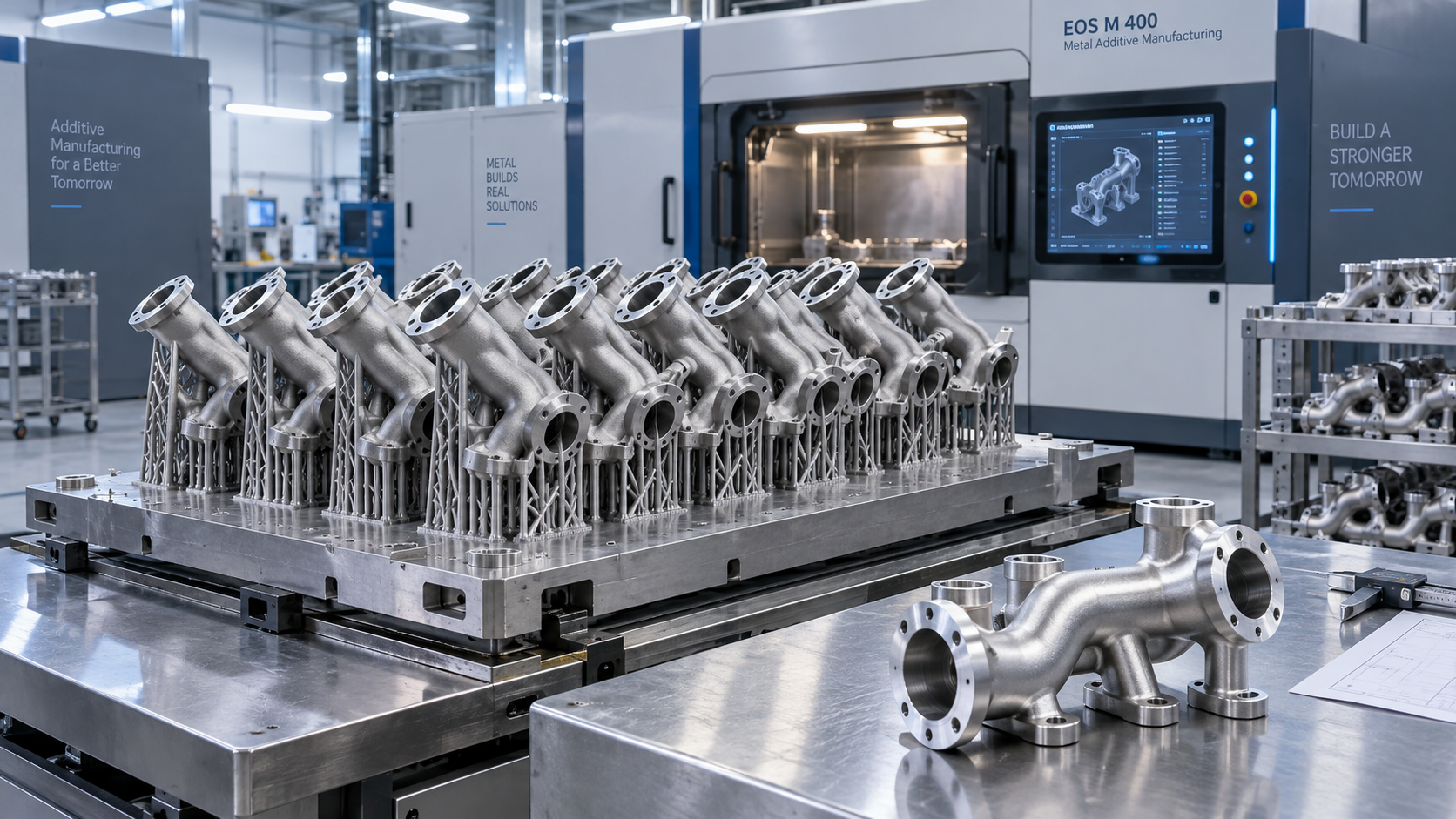
Yes, additive manufacturing is suitable for mass-producing selected metal parts, especially when complex geometry, reduced assembly work, or functional performance justifies the production cost. Its strongest applications combine a valuable design advantage with a repeatable manufacturing process. For simple components made in large, stable quantities, casting, forging, stamping, or machining frequently offers better economics and higher throughput.
The deciding question is whether the complete production route can deliver the required quantity of acceptable finished parts at a competitive cost. Printing speed alone cannot answer that question. Heat treatment, support removal, machining, inspection, and production losses all influence the result.
Where does metal additive manufacturing fit in volume production?
Metal additive manufacturing has a strong production case when it creates features that conventional processes struggle to produce economically. Internal cooling passages, compact fluid manifolds, lightweight structures, and assemblies consolidated into fewer components are examples. Their value comes from the finished component’s function and the operations eliminated elsewhere in production.
A printed manifold, for example, can replace intersecting drilled passages, plugs, and several joined components with an integrated flow path. That advantage disappears if the internal passages cannot be cleared of powder, inspected adequately, or finished to meet the pressure-loss requirement. Geometric freedom only creates production value when the resulting geometry remains manufacturable and verifiable.
Conversely, a straightforward bracket with accessible surfaces and uncomplicated holes offers little reason to absorb additive processing costs if stamping or machining already meets its requirements. A favorable comparison requires equivalent functionality, material properties, tolerances, and delivery volume.
There is no universal annual quantity at which metal printing becomes unsuitable. A small intricate component and a large solid component consume very different machine capacity. Even equal quantities of parts made from the same alloy can have substantially different production economics.
Which metal printing process changes the answer?
“Metal 3D printing” covers processes with different production constraints. Choosing a process determines which geometries, finishing operations, and capacity limits matter most.
Laser powder bed fusion selectively melts powder and can produce intricate features, but each build includes layer spreading and scanning. Increasing the number of lasers can raise throughput, although the result depends on scan allocation, thermal behavior, and the qualified process parameters. Machine specifications alone do not establish finished-part output.
Binder jetting separates printing from densification. Its potential for batch throughput is attractive, but the printed component must survive handling and undergo debinding and sintering. Shrinkage compensation, furnace loading, and distortion control become central production tasks. A successful print does not establish that the final dimensions will be acceptable.
Directed energy deposition suits a different geometry range. Its relatively coarse deposited features often require substantial machining. It deserves consideration when the objective is to add material efficiently to a large component, rather than reproduce fine internal channels.
Why does part orientation affect production cost so much?
In powder bed fusion, orientation changes build height, support requirements, surface quality, and the direction of material properties. A taller arrangement requires more layers. A flatter arrangement can occupy more platform area or introduce difficult downward-facing surfaces. The orientation that fits the most parts onto a platform is therefore not automatically the least expensive.
Supports consume material and processing time, anchor parts during printing, and must later be removed. Supports inside inaccessible passages can make a design impractical. On external surfaces, their removal can leave marks that require machining or finishing, adding labor and dimensional risk.
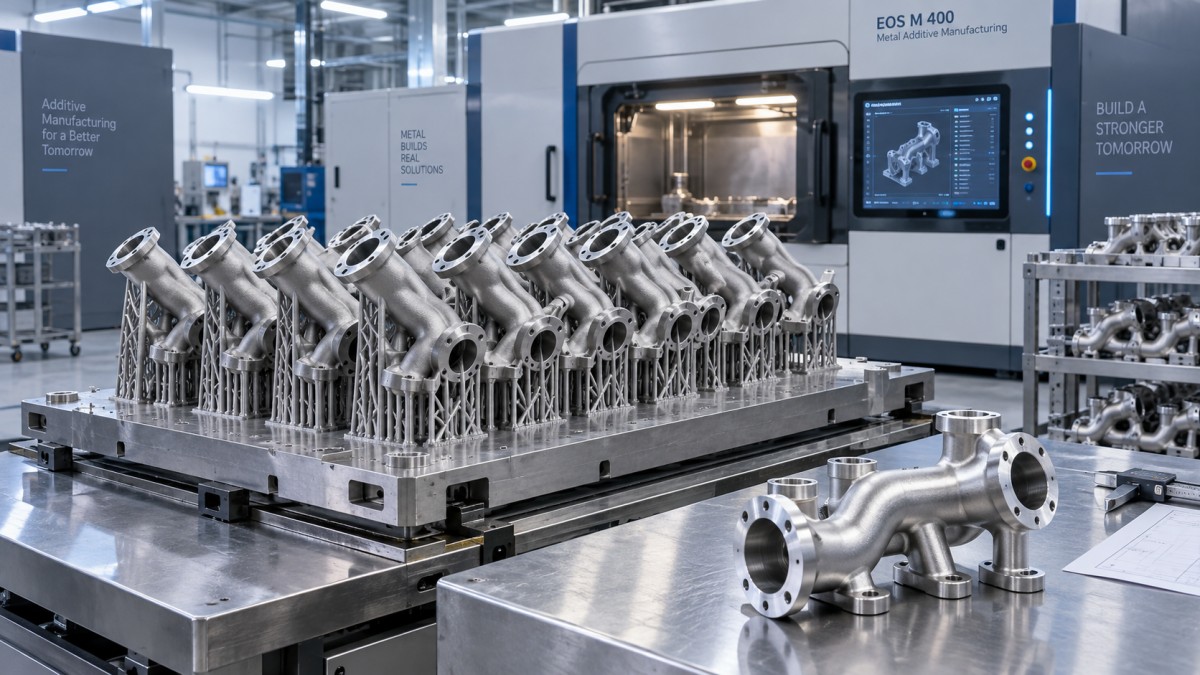
Orientation also determines whether critical surfaces remain accessible for finishing and measurement. A sealing face needs adequate machining allowance and a reliable locating method. A thin wall beside that face must withstand clamping and cutting forces after printing. These details connect additive design directly to the downstream production route.
Dense platform packing requires validation. Nearby parts affect heat distribution, and powder removal becomes harder around tightly arranged features. The production layout should demonstrate acceptable quality across the intended build positions, including the locations most likely to challenge the process.
Does a printable alloy behave like its wrought or cast equivalent?
An alloy designation alone does not establish equivalent performance. Additive processing creates a thermal history and microstructure that differ from casting or working metal into shape. Build direction, heat treatment, defects, and surface condition influence the finished properties.
For powder bed fusion, powder chemistry, particle-size distribution, flow behavior, and contamination affect process stability. Reused powder needs controlled handling and defined acceptance criteria. A supply of nominally identical alloy powder is insufficient if its condition falls outside the qualified process window.
Material availability also varies by process. Stainless steels, titanium alloys, aluminum alloys, and nickel-based alloys each present distinct processing issues. Some aluminum compositions are susceptible to cracking under particular melting conditions; titanium requires careful control of reactive contamination. The exact alloy and process combination needs evidence supporting the intended application.
Post-processing must address the actual failure mechanism. Stress relief reduces residual stress, while other heat treatments modify microstructure and properties. Hot isostatic pressing can reduce certain internal pores, but it does not remove every defect or correct inaccessible rough surfaces. Where fatigue governs performance, surface condition and defect location require attention alongside density measurements.
How should cost be compared with casting, forging, or machining?
Compare the cost per accepted finished part. A printing quotation that excludes machining, heat treatment, or inspection cannot be compared directly with a quotation for a ready-to-use conventional component.
The additive cost calculation should include feedstock, machine occupancy, setup, support material, powder handling, thermal processing, separation from the build plate, finishing, inspection, and losses. Shared batch costs need allocation across the parts that pass final acceptance.
Rejected parts matter because defects are sometimes discovered late. A component rejected after machining has already consumed printing capacity, thermal processing, and finishing time. Yield measured immediately after printing can therefore overstate the economic performance of the complete route.
Conventional manufacturing has a different cost structure. Casting and forging introduce tooling and development costs, but those costs spread across larger production quantities. Machining consumes stock material and cutting time, yet it offers strong economics for accessible geometry and stable automated operations. Additive manufacturing avoids some tooling expenses while retaining substantial machine and finishing costs.
Design consolidation also changes the comparison. If one printed part replaces several components, include the eliminated joining, assembly, leak testing, and inventory handling where applicable. Count only operations that the final design actually removes. A consolidated component that still needs extensive machining and inspection may deliver a smaller saving than its reduced part count suggests.
Can a printing fleet deliver the required production rate?
Capacity depends on the complete cycle, including preparation, printing, cooling, unloading, cleaning, and maintenance. Multiplying nominal build speed by available hours overlooks the periods when the machine cannot begin another production build.
A useful starting relationship is:
Accepted output per period = completed builds × parts per build × final acceptance yield.
This relationship needs realistic operating assumptions. The number of completed builds must reflect downtime and changeovers, while acceptance yield must cover the entire route through finishing and inspection. Mixing the yield from one stage with the cycle time from another creates an inflated capacity estimate.
Downstream equipment can become the limiting resource. Furnaces process batches; machining centers require fixtures and cutting time; inspection has its own cycle and availability. Adding printers increases usable output only when those operations have sufficient capacity.
Scheduling introduces another constraint. A build packed with different part numbers can improve machine utilization, but it ties their completion times together. Different heat treatments or inspection requirements may then split the batch into separate routes. Stable, repeatable product families are easier to scale than a continuously changing mix of unrelated geometries.
What evidence establishes repeatable production quality?
A successful prototype proves that a part can be made under particular conditions. Serial production requires evidence that the intended process consistently produces acceptable parts across builds, locations, material lots, and relevant operating conditions.
Acceptance criteria should follow the component’s function. A pressure-containing part needs evidence addressing leakage and pressure integrity. A fatigue-loaded part requires attention to defects and surface condition. Dimensional inspection alone cannot establish either outcome.
Production records should connect each part or batch to its feedstock, machine, build parameters, orientation, thermal processing, and inspection results. That connection supports investigation when a result drifts and helps identify the affected production scope.
Machine monitoring provides useful process signals, but those signals need a demonstrated relationship with defects or acceptable quality. An apparently stable melt-pool trace does not independently establish that every internal feature meets requirements. Likewise, a witness specimen cannot fully represent thermal conditions in every location of a complex component.
Inspection access belongs in the design discussion. Internal channels may need computed tomography, leak testing, flow testing, or a combination selected for the defect types and acceptance limits. Computed tomography has limitations related to part size, material, geometry, and resolution; it is not a universal answer for every printed metal component.
When is a production trial sufficient to support scale-up?
A useful trial follows the proposed production route through final acceptance. Printing a few parts and measuring their external dimensions leaves the most consequential questions unresolved if production will also involve stress relief, support removal, machining, and internal inspection.
The trial should use representative platform loading and intended fixtures. It should record actual cycle times, finishing effort, dimensional variation, and rejection causes. Repeated builds are needed to distinguish a repeatable process from a favorable individual result.
Scale-up evidence also needs to cover the proposed equipment arrangement. Transferring a proven design to another machine can introduce differences in calibration, gas flow, laser behavior, or thermal conditions. The transfer requires defined verification appropriate to the part’s requirements.
A practical commitment point is reached when the process delivers acceptable finished parts at the required rate, with measured costs and a controlled production route. If that evidence exists only at the printing stage, the economics and capacity of mass production remain unproven.
Related Intelligence