
Industrial Software Security: Common Vulnerabilities in Connected Factory Systems
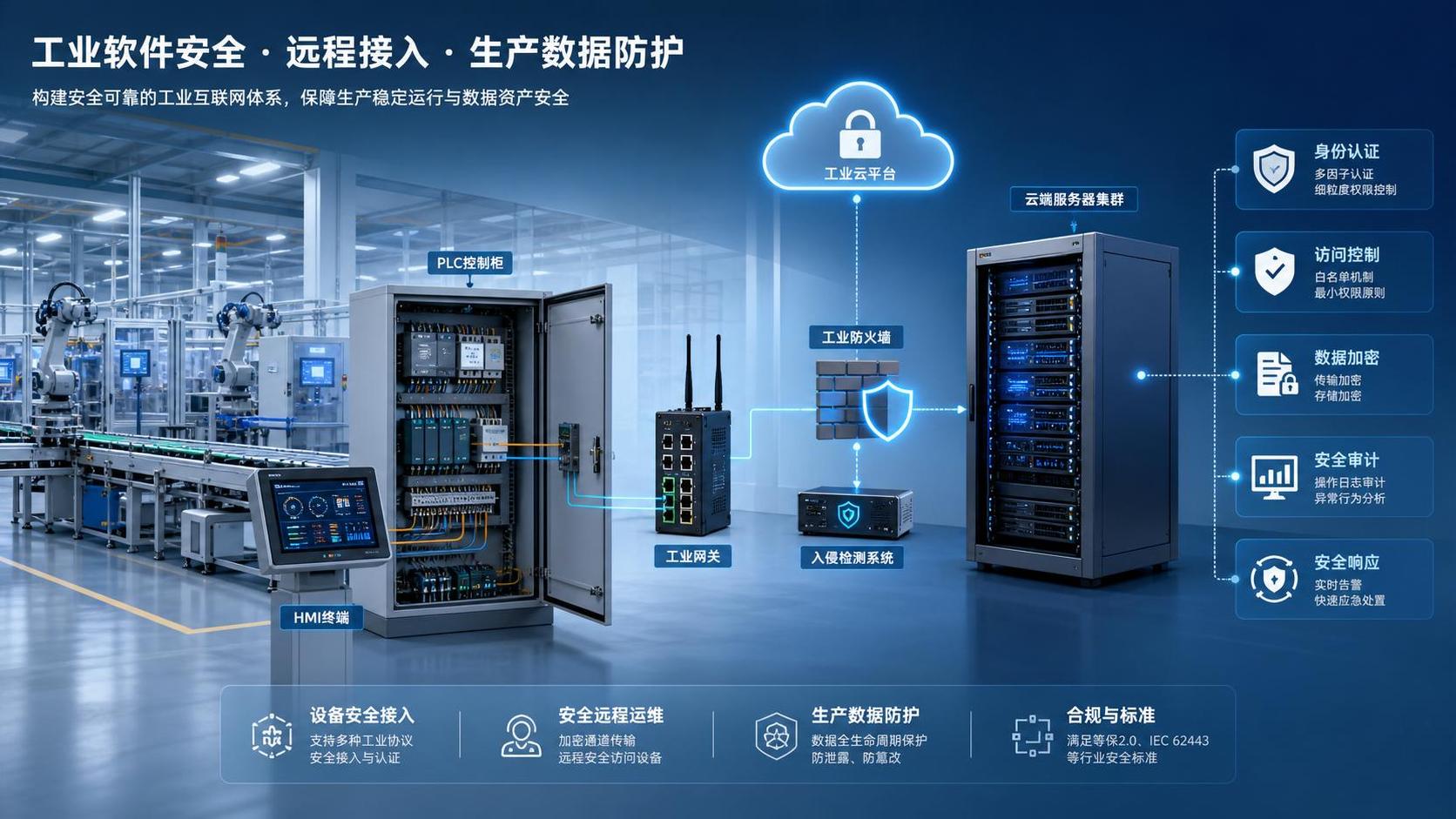
Why industrial software security now shapes factory performance
Connected production is no longer limited to PLCs and isolated SCADA screens.
Factories now exchange data with MES, ERP, cloud dashboards, remote service tools, and supplier platforms.
That wider connection improves visibility, but it also expands the attack surface.
Industrial software security matters because disruption in a factory is rarely just an IT inconvenience.
A weak authentication setting can stop a packaging line.
An exposed engineering workstation can alter process parameters.
A vulnerable gateway can leak production recipes, maintenance records, or export-sensitive technical data.
In practice, industrial software security sits at the intersection of production continuity, safety, compliance, and supply chain resilience.
This is why industrial analysis platforms increasingly treat cybersecurity as an operational issue, not only a technical one.
The real risk changes with the operating scene
Not every connected factory system fails in the same way.
The main vulnerabilities depend on how software interacts with equipment, people, and external networks.
A discrete assembly plant often worries about downtime from misconfigured endpoints and delayed patching.
A metals processor may focus more on process integrity, recipe protection, and environmental safety controls.
A global factory group usually faces another layer of risk.
Remote support, multi-site access, supplier data exchange, and cross-border compliance create more complex security boundaries.
The useful way to assess industrial software security is to start with business flow.
Ask where production data comes from, who can change it, which systems depend on it, and what happens when that chain breaks.
Where production-line software becomes the weak point
On the shop floor, the most common issue is not always sophisticated malware.
More often, industrial software security gaps start with legacy HMIs, unpatched operator stations, shared passwords, and flat networks.
These weaknesses become serious when production software directly controls sequencing, alarms, tolerance settings, or machine interlocks.
In high-volume manufacturing, even a short interruption can trigger scrap, rework, and missed delivery windows.
The judgment point here is not only whether software has known CVEs.
It is whether that software can be changed without approval, whether logs are trustworthy, and whether backup images can restore operations quickly.
For factories introducing automation upgrades, industrial software security should be reviewed together with change control.
If a new HMI, historian, or edge device is added without segmentation, convenience can quietly become a new failure path.
What deserves closer inspection on the line
- Default accounts on PLC tools, HMIs, and engineering laptops
- Unencrypted industrial protocols crossing plant or vendor networks
- Shared administrator privileges for maintenance and operations
- Patch delays caused by fear of stopping production
- No tested recovery images for critical control software
When cloud dashboards and remote access improve visibility but widen exposure
Factory digitalization often starts with a reasonable goal.
Teams want better OEE data, remote diagnostics, energy monitoring, or centralized maintenance records.
The problem appears when industrial software security is treated as an add-on after connectivity is already live.
Remote access tools, cloud APIs, and browser-based management platforms create new identity and session risks.
In this scene, the key question is not whether cloud is safe or unsafe.
The better question is whether access is limited by role, time, device, and task.
A vendor should not have the same permissions as an internal process engineer.
A maintenance session should not remain open after service ends.
Cloud-connected plants also need to decide which data can leave the site.
Operational metrics may be low risk, while formulas, material specifications, and production schedules can be commercially sensitive.
For export-oriented operations, industrial software security also overlaps with data governance and contractual obligations.
Process industries and metals operations face different consequences
In batch processing, heat treatment, smelting, coating, or chemical handling, a software error can create more than downtime.
It can alter temperature windows, pressure control, traceability records, or emissions behavior.
That changes how industrial software security should be prioritized.
In these environments, integrity often matters as much as confidentiality.
A hidden modification to a setpoint can produce off-spec coils, defective castings, or unsafe downstream handling.
The more continuous the process, the harder it is to pause for emergency correction.
A practical review should examine historian trust, alarm logic protection, and the separation between safety systems and routine production software.
Many sites assume that if a control network is physically inside the plant, it is sufficiently protected.
That is a common misread.
USB updates, contractor laptops, and dual-homed devices often bypass that assumption.
Different scenes demand different security priorities
A single checklist rarely fits every connected system.
The table below highlights how industrial software security priorities shift by operating condition.
The mistakes that cause most security gaps
One frequent mistake is copying enterprise IT rules directly into operational technology.
Industrial software security must respect uptime limits, validation cycles, and safety dependencies.
Another mistake is focusing only on purchase-stage features.
A platform may support encryption and audit trails, but those controls still fail if implementation is weak.
There is also a tendency to treat similar factories as identical.
In reality, the same software behaves differently in a high-mix workshop, a continuous furnace line, or a warehouse-linked fulfillment network.
A broader industrial view matters here.
Industrial policy, supplier maturity, automation depth, and even cross-border service arrangements influence how industrial software security should be judged.
Common points that are overlooked
- Software bills of materials are missing for legacy industrial applications
- Third-party maintenance access is approved but not continuously monitored
- Backups exist, yet restore timing is never tested under production pressure
- Security patches are delayed without a compensating control plan
- Data classification is unclear between operational data and trade-sensitive data
How to adapt industrial software security without slowing operations
Useful adaptation starts with ranking systems by operational consequence, not by software category alone.
A recipe server, a quality traceability database, and a remote maintenance gateway may need stronger controls than less critical office-connected tools.
In actual deployment, a balanced roadmap usually works better than a one-time security project.
- Map software-to-process dependencies before changing network or access rules
- Separate production, safety, maintenance, and partner access paths
- Use role-based control for engineering changes and remote sessions
- Create patch windows linked to shutdown plans or equipment redundancy
- Test backup restoration against realistic recovery time targets
- Review external interfaces with suppliers, cloud tools, and logistics platforms
For organizations tracking industrial upgrading, sourcing risk, and digital transformation, this approach is more practical than chasing isolated security headlines.
It turns industrial software security into a decision framework tied to production value.
A useful next step is to judge the system by consequence
The most effective industrial software security decisions begin with scene-based comparison.
Review where software controls quality, where it affects safety, where it touches supplier or trade data, and where remote access crosses trust boundaries.
Then compare those scenes against recovery time, compliance exposure, and implementation difficulty.
That process makes priorities clearer than a generic checklist.
For ongoing factory digitalization, it is worth building a simple review standard for connected assets, access rights, patch timing, backup validation, and external data exchange.
Industrial software security becomes manageable when each control is linked to a real operating consequence.
That is the point where cybersecurity stops being abstract and starts supporting resilient industrial operations.
Related Intelligence