
Industrial Software Provider Comparison: MES, ERP, and SCADA Selection Criteria
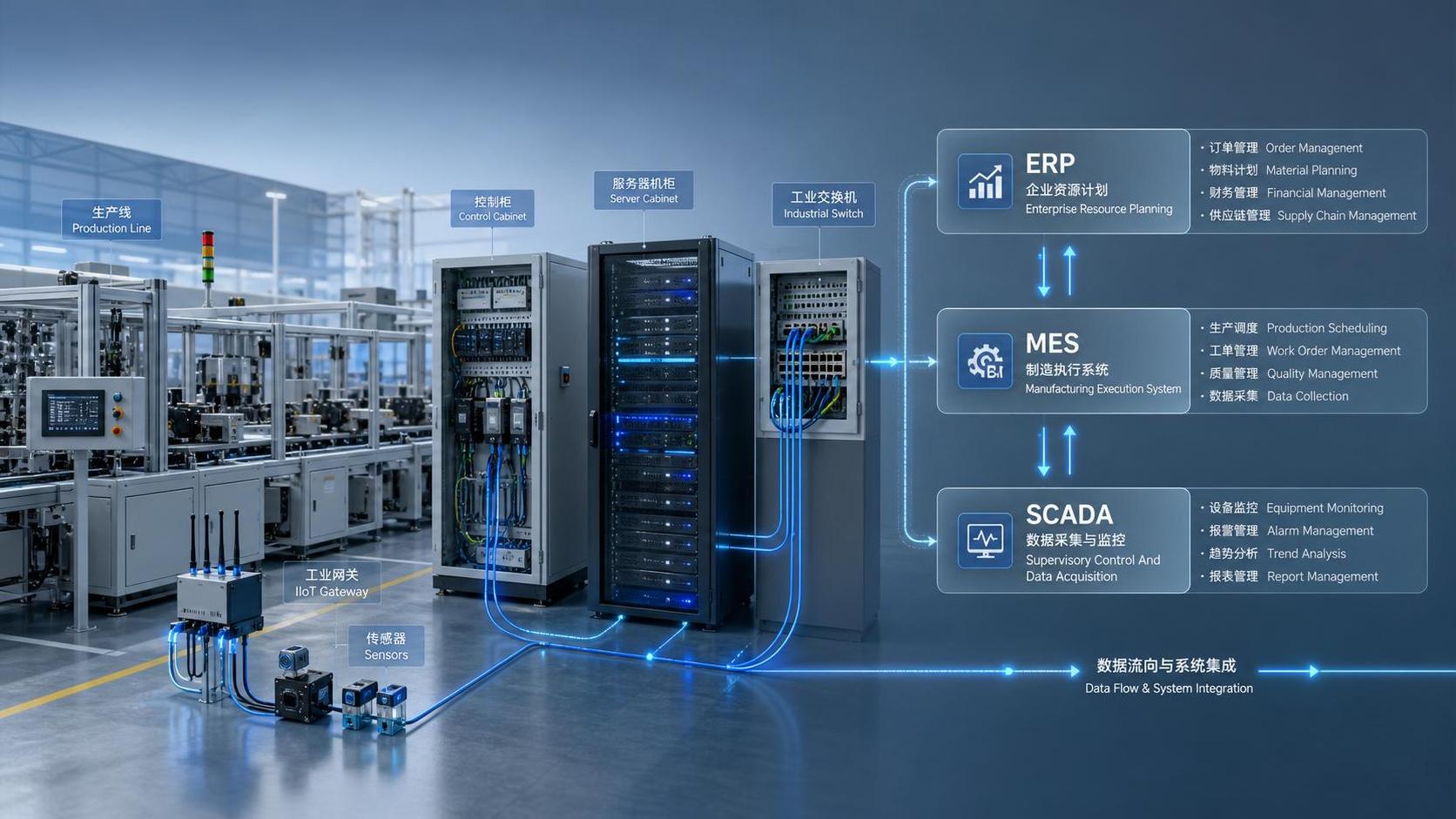
Industrial Software Provider Comparison: MES, ERP, and SCADA Selection Criteria
Choosing the right industrial software provider can determine how effectively a factory connects data, controls production, and supports decision-making.
For teams comparing MES, ERP, and SCADA, feature lists are only the starting point.
The harder question is whether the platform fits plant architecture, reporting needs, integration depth, and future expansion.
In practical terms, a weak choice creates data silos, manual workarounds, slow decisions, and higher long-term costs.
A strong industrial software provider helps connect shop floor events, business planning, and operational control without creating unnecessary complexity.
Understand What MES, ERP, and SCADA Actually Solve
Before comparing vendors, clarify the role of each system.
MES manages production execution.
It tracks orders, work-in-progress, quality records, labor, downtime, and production traceability in near real time.
ERP handles enterprise planning.
It covers purchasing, inventory, finance, order management, costing, and broader resource coordination across the business.
SCADA focuses on monitoring and control.
It collects machine and process signals, visualizes alarms, supports supervisory control, and connects operators with field equipment.
The first selection mistake is expecting one platform to do everything equally well.
A credible industrial software provider should clearly define where its product is strongest, where integration is required, and where limitations begin.
Start With Business Process Fit
From recent market shifts, process fit matters more than broad functionality claims.
A provider may show hundreds of modules, yet still fit poorly with actual plant workflows.
Start by mapping critical use cases:
- production scheduling and dispatching
- batch or discrete traceability
- quality inspection and nonconformance handling
- equipment alarms and downtime analysis
- inventory synchronization with planning
- multi-site reporting and standardization
Then ask each industrial software provider to demonstrate those workflows with realistic plant data.
If the demo relies on generic slides instead of process scenarios, selection risk rises quickly.
Evaluate Architecture Before Features
A good interface means little if the architecture cannot support your environment.
This is especially important when comparing an industrial software provider across MES, ERP, and SCADA categories.
Review these architecture points early:
- on-premise, cloud, or hybrid deployment
- support for edge connectivity and local buffering
- database structure and data retention strategy
- high availability and disaster recovery options
- role-based access and audit trail design
- open APIs, OPC UA, MQTT, and common industrial protocols
In real operations, architecture weaknesses appear long after go-live.
That includes unstable connectors, slow historian queries, or limited support for plant expansion.
A reliable industrial software provider should explain architecture in technical depth, not just at a marketing level.
Check Integration Depth, Not Just Integration Claims
Integration is where many projects lose momentum.
An industrial software provider may claim compatibility with PLCs, sensors, warehouse systems, and finance tools.
The real question is how much engineering work is still required.
Ask for concrete answers on four levels:
- Device integration: Which controllers, gateways, and protocols are already proven?
- Application integration: How does data move between MES, ERP, SCADA, WMS, and QMS?
- Semantic integration: Are production events, product codes, and quality records consistently defined?
- Maintenance integration: Who owns connector updates after version changes?
This matters because poor integration creates duplicated master data and conflicting reports.
When comparing an industrial software provider, verified interfaces carry more value than long compatibility lists.
Focus on Scalability and Performance Under Real Load
Selection should reflect where operations are going, not only where they are today.
A smaller plant may only need basic visibility now.
Within two years, it may require multi-line scheduling, energy tracking, traceability expansion, or cross-site dashboards.
Ask each industrial software provider to quantify system limits.
Scalability should be proven with references, benchmarks, and implementation cases close to your industry profile.
Assess Usability on the Shop Floor
Software decisions often lean too heavily toward management reports.
Yet actual adoption depends on operators, supervisors, maintenance staff, and planners.
A capable industrial software provider should show how the interface works in fast, noisy, time-sensitive environments.
Review whether the system supports:
- clear alarm handling and escalation paths
- simple batch input and barcode workflows
- touchscreen or tablet operation
- multi-language labels where needed
- context-based permissions
- fast exception handling without excessive clicks
In day-to-day business, usable software drives cleaner data and stronger process discipline.
Review Vendor Capability Beyond the Product
Software quality alone does not guarantee project success.
The industrial software provider must also have implementation discipline.
That includes industry knowledge, documentation quality, support responsiveness, and long-term product direction.
Use this short vendor review checklist:
- How many similar deployments are live?
- Can the provider share relevant customer references?
- What is the upgrade policy for custom functions?
- Is local or regional support available?
- How are cybersecurity patches and compliance handled?
- What training is included for plant and IT teams?
A mature industrial software provider will answer these questions with evidence, not broad promises.
Watch for Common Selection Risks
Several warning signs appear repeatedly in industrial software selection projects.
The more obvious signal is over-customization during early discussions.
That often means the base product does not match core workflows.
Another risk is selecting separate tools without a coherent integration roadmap.
This creates local optimization but weak enterprise visibility.
A third risk is underestimating data governance.
Without clear ownership of master data, reports quickly lose credibility.
A careful industrial software provider should raise these risks proactively during evaluation.
Build a Practical Selection Method
To make decisions more defensible, use a weighted scoring model.
In actual business settings, this keeps debate focused on measurable criteria.
- Define must-have processes for MES, ERP, and SCADA coverage.
- Set technical criteria for architecture, integration, and cybersecurity.
- Score each industrial software provider against real scenarios.
- Run reference checks with similar factories or supply chain structures.
- Estimate total cost across licensing, deployment, support, and upgrades.
- Pilot the highest-risk workflow before final commitment.
This also helps separate short-term presentation strength from long-term operational fit.
For industrial companies working on automation, factory digitalization, and supply chain visibility, software selection should support broader transformation goals.
The best industrial software provider is rarely the one with the longest feature sheet.
It is usually the one that fits process reality, integrates cleanly, scales predictably, and remains supportable over time.
That is the standard worth using when comparing MES, ERP, and SCADA options.
A disciplined evaluation now will reduce project risk later and produce better digital decisions across production, operations, and supply chain management.
Related Intelligence