
RCEP Testing Recognition Cuts Repeat Checks

On June 4, 2026, an RCEP ministerial trade facilitation meeting announced the signing of a mutual recognition framework for conformity assessment covering 12 categories of industrial safety equipment. For Chinese exporters of products such as emergency stop buttons, safety light curtains, and explosion-proof motors, the change matters because test reports issued by CNAS-accredited laboratories in China will be directly accepted by regulators in Japan, South Korea, Australia, New Zealand, and the 10 ASEAN member states, removing repeat type testing in those markets. For manufacturers, exporters, buyers, certification teams, and supply chain operators, this is not just a trade headline; it is a rules change that can affect compliance preparation, document handling, delivery timing, and market access workflows.
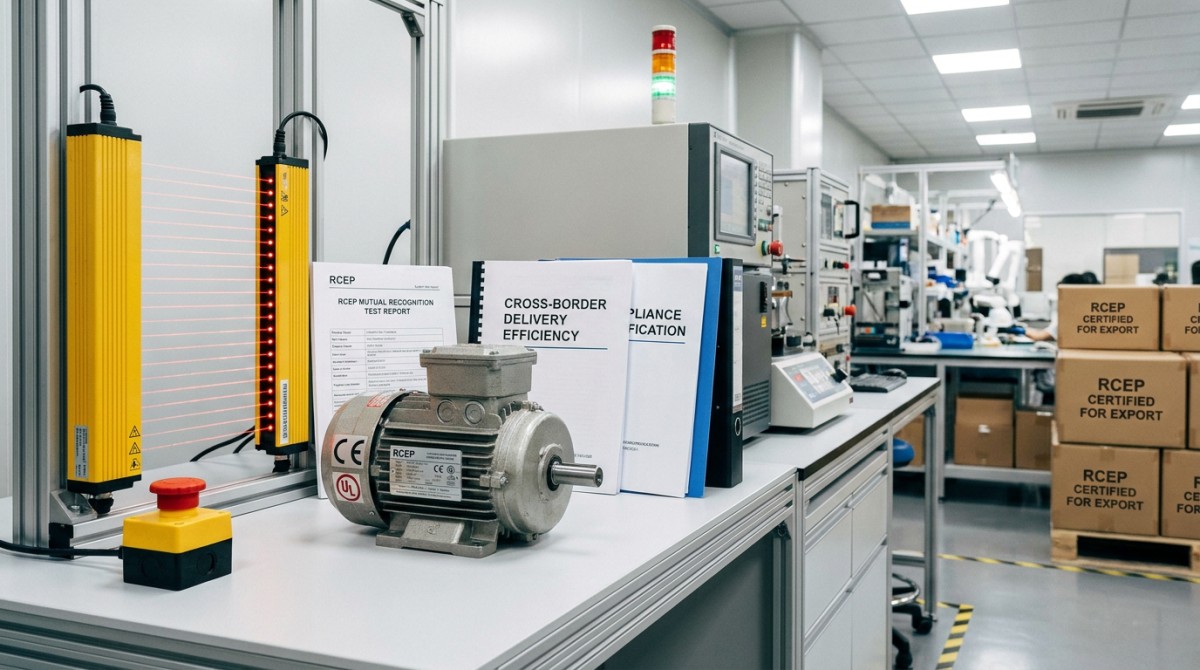
What has been agreed and when it takes effect
According to the announced information, the 5th RCEP Ministerial Meeting on Trade Facilitation confirmed the signing of the Framework for Mutual Recognition of Conformity Assessment for Industrial Safety Equipment on June 4, 2026. The framework covers 12 categories of industrial safety equipment, including emergency stop buttons, safety light curtains, and explosion-proof motors.
The confirmed change is that test reports issued by CNAS-accredited laboratories in China will be directly recognized by regulatory authorities in Japan, South Korea, Australia, New Zealand, and the 10 ASEAN member states. The announced effect of that recognition is the removal of repeat type testing for applicable products.
The framework is scheduled to enter into force on October 1, 2026. The first batch of eligible product listings has also been released at the same time.
Where the practical impact is likely to appear first
Export manufacturers may see compliance work shift upstream
From an industry perspective, manufacturers shipping covered industrial safety equipment from China are among the most directly affected. The main reason is straightforward: if a product falls within the first applicable list, laboratory testing completed through a CNAS-accredited laboratory may no longer need to be repeated in each covered destination market.
The likely operational impact is not only in testing cost or timing, but also in how companies organize product files before shipment. What deserves closer attention is whether internal export teams clearly map product scope, laboratory qualifications, and report completeness against the newly released applicable list.
Procurement and project buyers may revise supplier review logic
Buyers of industrial safety equipment, especially those sourcing across multiple RCEP markets, may also need to adjust supplier qualification checks. Analysis shows that when a single test report can support acceptance in multiple markets, procurement teams may place greater emphasis on whether the supplier's testing documents are issued by an eligible CNAS laboratory and whether the product is within the framework's covered categories.
In practice, the effect may appear in tender documents, approved vendor lists, technical submission packages, and pre-shipment compliance review. The key point is not that all procurement requirements will automatically become identical, but that testing recognition may become a more visible part of supplier comparison and bid documentation.
Certification and testing service providers may face changes in document expectations
For laboratories, certification support teams, and compliance service providers, the framework may change client demand from repeated country-by-country testing toward documentation accuracy and report usability across jurisdictions. Observably, this can raise the importance of report format, technical consistency, supporting files, and traceability records.
That said, the announced information confirms recognition of CNAS laboratory test reports and the removal of repeat type testing for covered products; it does not, by itself, provide every execution detail that service providers may need. As a result, these firms should watch how the framework is reflected in practical filing, submission, and regulator acceptance processes after the effective date.
Logistics and delivery planning could be affected through approval timing
Supply chain and delivery teams may also be affected indirectly. If duplicate type testing is removed for eligible exports, product release planning, customs preparation, customer acceptance scheduling, and installation timelines may all be influenced by a shorter or more predictable compliance path. However, this should be treated as an operational possibility rather than a confirmed outcome for every shipment, because actual timing will still depend on execution rules and customer-side requirements.
What companies should verify before October 1
Check whether the product is on the first applicable list
The first practical checkpoint is scope. Companies should confirm whether their products are included in the first released list of applicable products rather than assuming all industrial safety equipment will benefit immediately. This matters for export planning, quotation terms, and customer communication.
Review whether laboratory documents are ready for cross-market use
Analysis shows that the value of mutual recognition depends heavily on document usability. Exporters should review whether their test reports come from CNAS-accredited laboratories and whether technical files, model descriptions, and supporting materials are organized in a way that can be presented consistently across multiple RCEP markets.
Monitor official wording and regulator-side execution practice
What deserves closer attention is the execution layer after the framework takes effect on October 1, 2026. The announced information confirms direct recognition and the removal of repeat type testing, but companies should still monitor how authorities, buyers, and import-side reviewers express document acceptance in practice. This is particularly relevant for sales contracts, compliance declarations, and submission packages.
Align delivery schedules and customer commitments cautiously
For exporters and project suppliers, it would be prudent to align shipment planning and customer promises with the effective date and the product coverage actually confirmed. Until implementation practice becomes clearer, companies should avoid treating the framework as a blanket replacement for all compliance steps in every transaction.
Why this looks like an execution signal, not just a policy headline
Observably, this development is more than a general statement of trade cooperation because it identifies covered equipment categories, confirms direct acceptance of CNAS laboratory reports in multiple RCEP markets, and sets a clear effective date of October 1, 2026. In that sense, it is more appropriate to understand this as a concrete execution signal tied to conformity assessment and market entry procedures.
At the same time, analysis shows that the market significance will depend on how consistently the framework is reflected in regulator handling, procurement documents, and customer-side compliance review after it takes effect. For that reason, the announcement should not yet be read as meaning that every cross-border compliance friction has been removed. The more realistic reading is that one important layer of repeat testing may be reduced for covered products, while implementation details still deserve close observation.
How the market may best read this change for now
At this stage, the announcement points to a real rules change in industrial safety equipment trade within the RCEP framework: eligible products supported by CNAS laboratory reports in China may enter multiple member markets without repeat type testing once the framework becomes effective. For exporters, buyers, and compliance teams, the immediate significance lies in preparation rather than assumption—checking product scope, document readiness, and market-side acceptance practice.
It is more appropriate to understand this development as a meaningful reduction in repeated conformity assessment for covered products, combined with a need to keep watching how the rule is applied in actual transactions, tenders, and regulatory review after October 1, 2026.
Basis of this article and what still needs verification
This article is based on the user-provided news title, event date, and event summary. For developments of this kind, commonly relevant source types may include official government announcements, regulatory authority releases, customs or trade administration information, industry association updates, standards-related documents, and reporting by authoritative media.
No specific official source link was provided in the input, so the exact official publication path still needs to be verified on an ongoing basis. What should continue to be monitored includes any detailed implementation wording, regulator-side acceptance practice, changes in tender or procurement documents, industry feedback, and how companies execute the new recognition arrangement in real export and delivery scenarios.
Related Intelligence