
Toy Wholesale Minimum Order Quantities: Cost and Margin Trade-Offs
Why do minimum order quantities matter so much in toy wholesale?
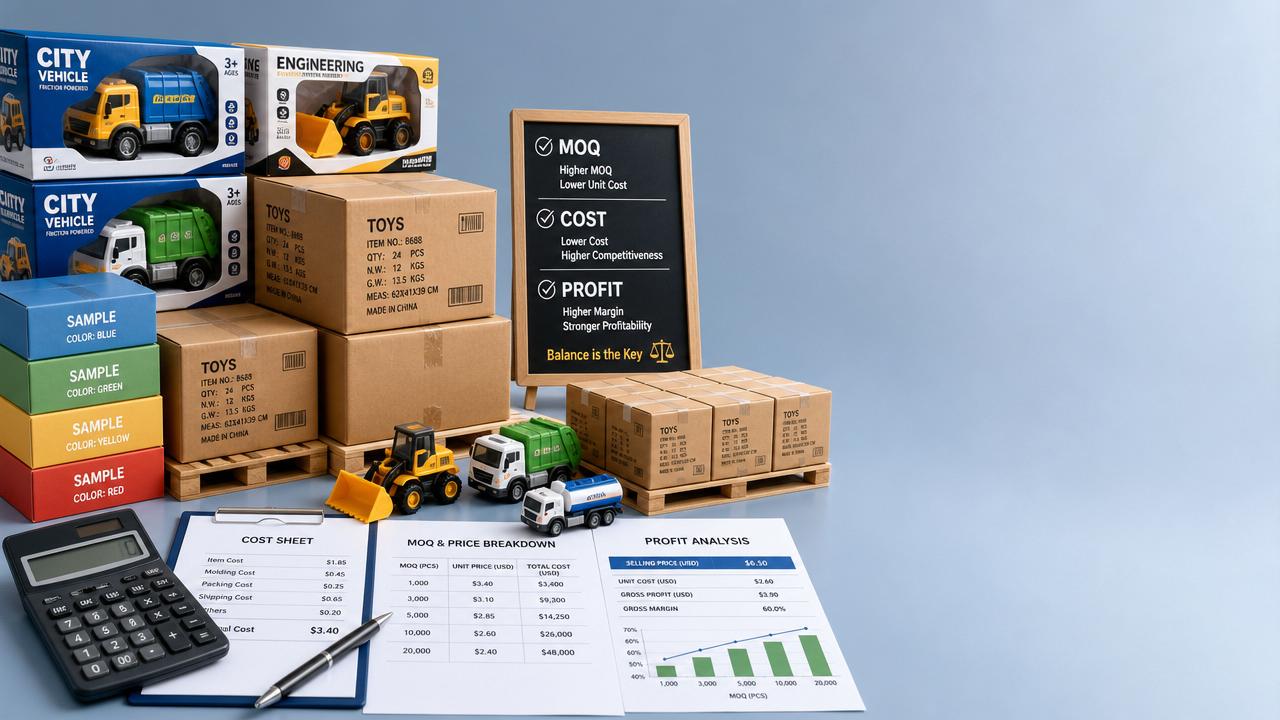
In toy wholesale, MOQ is not just a supplier rule. It is a pricing lever that affects cost, cash flow, and speed to market.
A lower MOQ usually feels safer. It reduces inventory pressure and allows faster testing of new product lines.
The trade-off is simple. Smaller orders often come with higher unit prices, fewer packaging options, and weaker freight efficiency.
Larger orders can improve margins. They may unlock better ex-factory pricing, more stable production scheduling, and stronger negotiation room.
But higher volume also increases risk. If sell-through is slower than expected, the apparent discount can turn into expensive stock.
That is why MOQ decisions in toy wholesale should never be isolated from logistics, compliance, and market timing.
A practical sourcing view connects manufacturing terms with supply chain reality, which is also how Baozhen Industrial Intelligence Portal approaches procurement topics.
Is a lower MOQ always better when demand is uncertain?
Not always. A low MOQ helps when demand is unclear, but it can quietly reduce resale competitiveness.
For example, a trial order may carry a higher mold allocation, higher packaging cost, and less favorable shipping consolidation.
That means the landed cost rises before the toy even reaches the warehouse. Margin pressure starts early.
In actual sourcing, the better question is not whether MOQ should be low. It is whether the order volume matches the certainty of demand.
Low MOQ works well in several situations:
- Testing a new category with little sell-through history.
- Entering a seasonal market with short sales windows.
- Checking packaging response across different channels.
- Reducing exposure to safety or compliance revisions.
A higher MOQ makes more sense when demand is repeatable, shipping lanes are stable, and product specifications are already proven.
Toy wholesale becomes more profitable when MOQ aligns with turnover speed, not when it simply looks flexible.
Where does the real margin gain come from: factory price or total landed cost?
Many sourcing discussions focus on unit price. In reality, margin in toy wholesale is shaped more by total landed cost.
A supplier may offer a 6% price break at a higher MOQ. That looks attractive on paper.
However, if that larger order extends storage time, requires extra handling, or slows cash recovery, the gain can shrink quickly.
The most common cost elements include production, packaging, carton utilization, freight, import duties, quality inspection, and warehousing.
The table below shows how MOQ choices often change the economics.
More often than not, the best margin comes from a balanced MOQ, not the biggest one available.
This is especially true when freight rates fluctuate or import rules change during the sales cycle.
How can you judge whether a supplier MOQ is reasonable?
A reasonable MOQ should reflect production logic, not just supplier preference.
If a toy uses custom color boxes, dedicated molds, or special battery packaging, a higher MOQ may be justified.
If the item is a standard design with common materials, an unusually high MOQ deserves closer review.
A practical way to assess toy wholesale MOQ is to ask what exactly drives the threshold.
- Does the MOQ come from raw material purchasing batches?
- Is it linked to carton quantities or pallet optimization?
- Does printing require a minimum run length?
- Is there a separate MOQ for each color, style, or assortment?
These details matter because a quoted MOQ can sometimes be split across variants, which improves flexibility without hurting production efficiency.
It is also worth checking whether the factory can stage deliveries. One production run with two shipment dates may reduce stock pressure.
This kind of negotiation sits at the intersection of manufacturing, warehousing, and trade execution, not just price bargaining.
What mistakes make toy wholesale MOQs more expensive than expected?
The most expensive MOQ mistake is chasing a lower unit price without measuring inventory velocity.
Slow turnover creates hidden costs. Storage, markdowns, damaged packaging, and tied-up cash all weaken the final margin.
Another common error is treating all toys the same. Plush items, electronic toys, and seasonal novelty lines carry very different risk profiles.
There is also a compliance angle. If labeling, testing, or destination market rules change, larger stock can become harder to move.
The following checklist helps spot avoidable problems before confirming a toy wholesale order.
- Do not compare MOQs without comparing landed cost per sellable unit.
- Do not ignore carton fill rate and container utilization.
- Do not assume higher volume always means better payment terms.
- Do not lock into custom packaging before demand is validated.
- Do not overlook testing lead time for regulated markets.
In broader supply chain terms, MOQ should be reviewed together with replenishment speed and route reliability.
That broader view is often more useful than a narrow price comparison.
When does a higher MOQ actually strengthen negotiating power?
A higher MOQ creates leverage only when it solves a real factory problem.
If larger volume improves line efficiency, reduces changeovers, or supports raw material planning, the supplier has room to negotiate.
That room can show up in several ways, not just a lower quoted price.
- Better payment structure or deposit ratio.
- Improved packaging quality or barcode support.
- Priority production slots during peak season.
- Partial customization without a sharp cost increase.
Still, volume should be offered carefully. A larger commitment only makes sense when replenishment data supports repeatability.
A useful middle path is a volume roadmap. Start with a manageable MOQ, then tie future increases to sell-through milestones.
This gives the supplier visibility while protecting margin discipline in toy wholesale.
What is a smarter next step before confirming a toy wholesale order?
The smartest next step is to convert MOQ into a decision model, not a yes-or-no debate.
Start with four numbers: target selling price, landed cost, expected monthly sell-through, and acceptable stock days.
Then test two or three order-volume scenarios. A medium MOQ often reveals the best balance between margin and flexibility.
It also helps to review packaging options, shipping method, and market compliance at the same time.
That integrated view reflects how industrial sourcing decisions are actually made across manufacturing, trade, and supply chain operations.
For ongoing research, platforms that combine market insight with practical procurement guidance can help frame better questions before negotiating.
In the end, toy wholesale MOQ decisions work best when they support both margin quality and operational resilience.
Review demand confidence, compare landed-cost scenarios, and confirm where volume truly improves economics before placing the next order.
Related Intelligence