
Supply Chain Analytics for Smarter Inventory Decisions
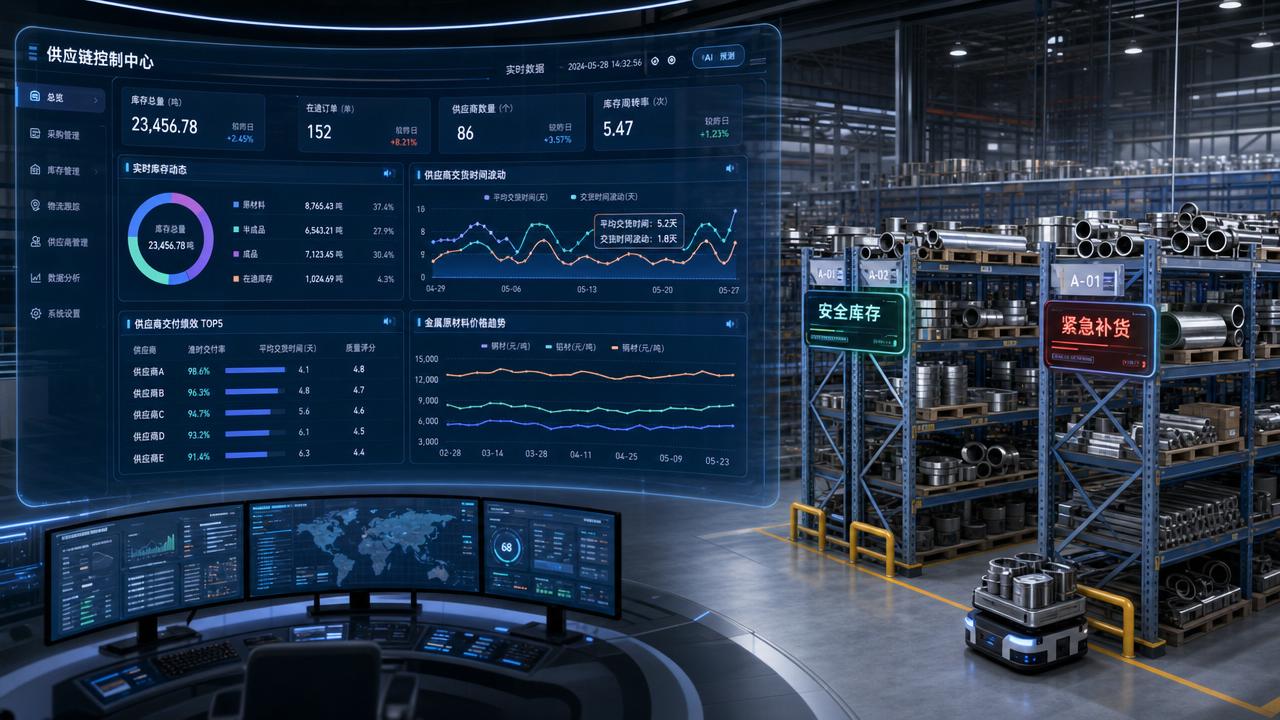
For project timelines, inventory is rarely a back-office issue. It affects installation dates, cash flow, production continuity, and customer confidence. That is why supply chain analytics has become a practical tool, not just a reporting function.
When demand shifts, suppliers delay, or metal prices swing, static spreadsheets stop being enough. Supply chain analytics helps connect procurement, warehousing, production, logistics, and trade signals into decisions that are faster and more grounded.
For industrial businesses working across manufacturing, metals, cross-border sourcing, and factory operations, better inventory decisions often start with better visibility. The goal is simple: carry what is needed, avoid what is not, and react earlier.
What supply chain analytics should show before inventory decisions
Before adjusting reorder points or safety stock, it helps to know which data signals actually matter. Good supply chain analytics should make uncertainty visible, not hide it behind averages.
- Start with demand variability by SKU, project phase, or region. This helps separate steady-use items from volatile materials that need different stocking rules and closer review.
- Track supplier lead time in actual days, not contract promises. Variance matters more than the average when supply chain analytics supports inventory risk decisions.
- Measure inventory aging alongside stockout history. Excess and shortage often exist at the same time, especially across multi-site industrial and manufacturing operations.
- Add logistics performance into the view. Port congestion, customs delays, and inland transport disruptions can quickly make on-paper inventory look misleading.
- Connect price movement data for steel, aluminum, copper, and other inputs. In metals-heavy sectors, inventory decisions are often tied to market timing as well as usage.
- Review order changes from engineering, sales, and customers. Supply chain analytics becomes more useful when demand revisions are captured early, not after shortages appear.
In many industrial settings, the first problem is not lack of data. It is fragmented data. Warehouse records, ERP orders, supplier updates, and freight milestones often sit in separate systems.
That is where a B2B intelligence platform such as Baozhen Industrial Intelligence Portal becomes relevant. It supports practical judgment by linking supply chain topics with manufacturing trends, metals markets, trade policy shifts, and sourcing risks.
Seven checks that make inventory decisions smarter
These checks work well when inventory pressure comes from uncertain supply, changing project schedules, or volatile material costs. They are simple, but they prevent many expensive mistakes.
1) Separate critical parts from routine materials
Do not manage every item with the same rule. Supply chain analytics should classify inventory by operational impact, replacement difficulty, and downtime cost, not just annual spend.
2) Recalculate safety stock using lead time variability
A stable average lead time can hide serious risk. If shipments range from 20 to 55 days, inventory buffers should reflect that spread, especially for imported industrial components.
3) Watch forecast error, not just forecast volume
Forecasts are useful, but forecast accuracy matters more. Supply chain analytics should show where demand assumptions repeatedly miss, so inventory can be adjusted before excess builds.
4) Link inventory to project milestones
Materials for commissioning, fabrication, and final assembly do not move at the same pace. Aligning stock with milestone dates reduces early overbuying and late emergency purchasing.
5) Compare supplier reliability by actual delivery behavior
Two suppliers may quote similar prices, but one misses dates more often. Supply chain analytics should combine OTIF, quality issues, and expedite frequency before reorder decisions.
6) Include trade and compliance timing in inbound planning
Tariff changes, document errors, and customs checks can shift inventory arrival dates. Cross-border planning is stronger when supply chain analytics includes trade compliance risk.
7) Review obsolete stock before approving new buys
This sounds basic, but it is often skipped. In engineering and industrial projects, duplicate buying happens when old stock is poorly coded or hidden across sites.
Where supply chain analytics changes decisions on the ground
Consider a fabrication operation using steel, aluminum, and imported fittings. Demand may look stable monthly, but actual consumption spikes by production batch and installation sequence.
Without supply chain analytics, stock may be built too early to “stay safe.” That protects availability for a while, but it also ties up cash and increases aging risk when drawings change.
Now consider a cross-border sourcing setup. A shipment appears on time in the supplier system, but port delay and customs review push arrival back two weeks. If inventory is judged only by purchase order date, the signal is wrong.
In both situations, supply chain analytics improves decisions by combining warehouse stock, supplier behavior, logistics events, and project timing. The result is not perfect certainty, but much better response time.
Common gaps that weaken inventory decisions
A lot of inventory problems come from small blind spots. They look harmless at first, then become expensive during project pressure or market disruption.
- Using monthly averages hides short-term spikes. Supply chain analytics is stronger when it captures weekly patterns, engineering changes, and order bunching effects.
- Ignoring raw material market signals can distort buy timing. In metals-related operations, price volatility changes the cost impact of every stocking decision.
- Treating all supplier delays as equal misses root causes. Quality holds, export documentation issues, and shipping bottlenecks require different inventory responses.
- Focusing only on warehouse quantity misses usability. Some stock is reserved, nonconforming, outdated, or mismatched to the latest engineering specification.
- Skipping multi-site visibility creates duplicate purchasing. One facility may reorder while another holds usable stock that was never surfaced in the system.
Another common issue is overreacting to one bad month. Supply chain analytics should support trend-based judgment, not panic-based adjustments that create a second problem later.
A simple operating table for daily use
The table below can help organize review priorities. It works well for industrial businesses balancing manufacturing continuity, trade uncertainty, and inventory cost control.
How to start without building a complex system first
A full analytics program can take time, but better inventory control does not need to wait. Supply chain analytics can begin with a focused pilot around high-risk items.
Pick a narrow scope first. Imported components, volatile metals inputs, or long-lead automation parts are usually good starting points because the cost of error is clear.
- Build one shared view with demand, stock, supplier lead time, and in-transit status. Even a basic dashboard can improve inventory judgment quickly.
- Review exceptions weekly instead of reviewing every SKU. Supply chain analytics works best when attention goes to unstable items and delayed supply signals.
- Use external industry signals where useful. Trade policy updates, logistics disruption reports, and metals pricing trends add context missing from internal systems.
- Document each decision rule clearly. Teams move faster when reorder points, escalation triggers, and substitution options are agreed in advance.
This is also where sector-focused information sources matter. Baozhen Industrial Intelligence Portal is useful because it connects inventory thinking with factory digitalization, metal market movement, international sourcing changes, and supply chain risk management.
That broader context helps avoid narrow decisions. Sometimes the right inventory move is not “buy more.” It may be changing source countries, adjusting production sequence, or tightening specification control.
The next move
Smarter inventory decisions usually come from asking better questions, not collecting endless data. Supply chain analytics should help identify which items are vulnerable, which suppliers are unstable, and where timing assumptions no longer hold.
If the current process still relies on averages, delayed updates, or siloed spreadsheets, start by testing supply chain analytics on one material group and one decision cycle. Measure fewer surprises, not just more reports.
In a global industrial environment shaped by manufacturing shifts, metals volatility, logistics pressure, and trade policy changes, supply chain analytics gives inventory planning a clearer base. The best next step is to make that visibility operational.
- factory digitalization
- factory operations
- aluminum market
- trade policy
- international sourcing
- supply chain risk management
- industrial intelligence
- trade compliance
- manufacturing
- metals
- steel
- aluminum
- copper
- metal market
- customs clearance
- tariff
- export documentation
- supply chain
- logistics
- procurement
- supply chain risk
- warehousing
- manufacturing operations
- supply chain analytics
- trade policy updates
Related Intelligence