
Baby High Chairs OEM: Cost, Compliance, and Lead Time
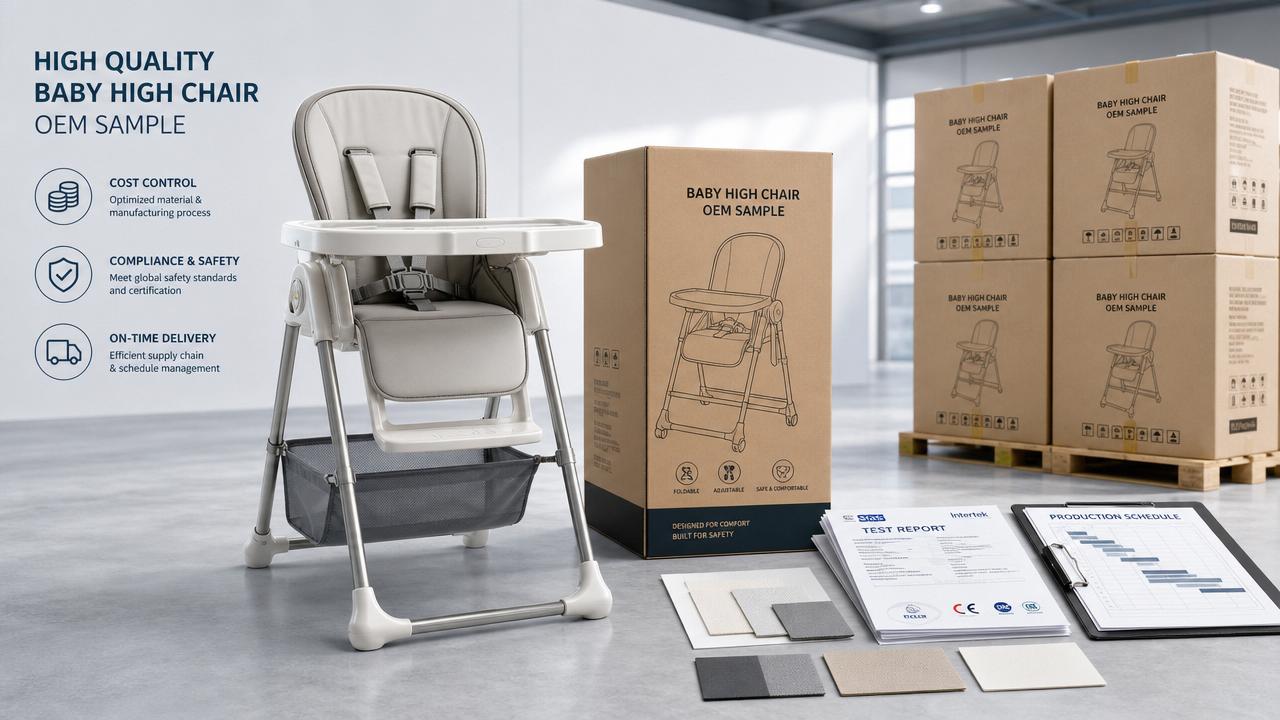
In baby high chairs OEM sourcing, unit price is only the visible layer of the decision. Behind the quotation sit product safety obligations, material specifications, tooling choices, packaging design, and shipment timing. For companies comparing suppliers across regions, the real question is not simply who offers the lowest price, but who can deliver compliant products with stable lead times and manageable supply risk.
That is why this category deserves closer attention. Baby products face tighter scrutiny than many general consumer goods, and a sourcing error can quickly turn into recalls, delayed launches, customs issues, or margin loss. From a broader manufacturing and global trade perspective, baby high chairs OEM projects sit at the intersection of product engineering, compliance control, factory capability, and cross-border supply chain execution.
What baby high chairs OEM really covers
A baby high chairs OEM arrangement usually means a buyer provides product positioning, performance targets, brand requirements, and commercial terms, while the factory handles manufacturing. In some cases, the supplier also contributes engineering adjustments, packaging support, or testing coordination.
The product itself can vary widely. Some models are simple plastic feeding chairs. Others combine metal frames, foldable mechanisms, adjustable trays, seat pads, wheels, harness systems, and compact shipping structures. Each added feature changes both cost structure and compliance exposure.
This is where Baozhen Industrial Intelligence Portal’s cross-sector lens is useful. A baby high chairs OEM decision is not only a manufacturing topic. It also involves raw material trends, export compliance, international logistics, and supplier risk management.
Why cost comparisons often become misleading
Two suppliers may quote similar-looking products at very different prices, yet the gap often comes from hidden technical and operational variables. Without breaking those variables apart, comparison becomes unreliable.
Main cost drivers in baby high chairs OEM
Raw material volatility matters more than many first estimates suggest. Steel tubing, aluminum parts, plastic resin, and packaging paper all move with market conditions. If a quotation has a long validity period but no material adjustment terms, margin exposure may be transferred later through renegotiation or quality substitution.
Labor content also deserves attention. A baby high chairs OEM program with more manual assembly points, fabric sewing, or inspection stages may look efficient in samples, yet become costly during scaled production.
Compliance is a cost issue and a market access issue
In baby high chairs OEM projects, compliance should not be treated as a final checkpoint. It directly shapes design feasibility, approved materials, documentation flow, and shipment release. If compliance is handled late, the result is often rework rather than smooth production.
Requirements differ by destination market. A supplier may have strong domestic production experience but limited familiarity with target-market standards. That gap can create risk even when the factory is otherwise capable.
Areas that usually require verification
- Mechanical safety, including stability, restraint strength, locking performance, and pinch-point control.
- Chemical compliance for plastics, coatings, inks, textiles, and accessory materials.
- Labeling, warnings, age grading, user instructions, and traceability markings.
- Packaging integrity for e-commerce, retail transit, and export handling.
- Document readiness, including test reports, bills of materials, and change records.
A practical point often missed is document consistency. Test reports, product drawings, carton labels, and production parts must match. A mismatch between approved samples and shipped goods can trigger disputes even if the product appears acceptable.
From a global trade perspective, compliance is also linked to customs clearance, retailer onboarding, and liability allocation. Baozhen Industrial Intelligence Portal frequently highlights this broader pattern across consumer product sourcing: technical conformity and trade execution can no longer be separated.
Lead time is shaped by more than factory capacity
Lead time in baby high chairs OEM sourcing is often discussed as a simple production number, such as 30 or 45 days. In reality, that figure only covers one part of the cycle. Total project timing begins much earlier and can extend well beyond ex-factory completion.
Typical lead time components
- Design review and engineering confirmation.
- Tooling development or mold modification.
- Material sourcing and incoming inspection.
- Pilot run, validation, and corrective actions.
- Mass production and in-line quality control.
- Final inspection, packaging release, and booking for shipment.
Tooling is especially important for new models. If the project requires custom trays, injection parts, or branded accessories, development timing can exceed the factory’s assembly cycle. A supplier that promises fast delivery without clarifying tooling status should be reviewed carefully.
Shipping mode also changes the real lead time. Ocean freight may support better landed cost, but it increases forecasting pressure. Air shipment can solve urgent shortages, yet it rarely works well for bulky products like high chairs unless the margin structure allows it.
How to compare suppliers beyond the sample stage
A good sample does not automatically prove production stability. In baby high chairs OEM evaluations, the stronger indicator is how the supplier controls repeatability once volume increases and specification changes begin.
Several operational signals can help separate an assembly vendor from a reliable long-term partner.
Signals worth checking
- Whether core components are made in-house or sourced from unstable subcontractors.
- How engineering changes are documented and approved.
- Whether critical dimensions and safety points have defined inspection standards.
- How the factory handles peak season capacity and urgent replenishment orders.
- Whether packaging tests and carton optimization are part of normal development work.
- How often material substitutions occur and who authorizes them.
Factory digitalization can improve confidence here. Suppliers using clearer production tracking, batch control, and defect reporting tend to provide more predictable outcomes. This aligns with the broader manufacturing trend toward smarter OEM management rather than purely labor-based output expansion.
Common sourcing scenarios and their different priorities
Not every baby high chairs OEM project should be evaluated by the same model. Priorities shift depending on the route to market and the product strategy behind the order.
This is why one universal supplier scorecard rarely works. The right baby high chairs OEM partner for a mature replenishment program may not be the best option for a new differentiated product line.
A practical evaluation framework
A more disciplined review usually starts with total landed and compliant cost, not quoted ex-works price alone. That means combining factory price, testing expense, packaging needs, freight assumptions, inventory timing, and failure risk.
It also helps to separate negotiable items from structural ones. Carton printing, accessories, and batch planning may be flexible. Safety design weaknesses, poor document control, or unstable material sourcing are much harder to fix later.
- Request a cost breakdown linked to materials, processes, and packaging.
- Confirm target-market compliance pathway before tooling is finalized.
- Review pilot production records, not only showroom samples.
- Map lead time from development through export departure.
- Check how the supplier manages change control and traceability.
- Stress-test the supply plan against peak season or port disruption.
For companies working across manufacturing, trade, and supply chain functions, this fuller view is increasingly necessary. It reflects the same decision logic seen across many categories tracked by Baozhen Industrial Intelligence Portal: procurement value comes from coordinated judgment, not isolated price comparison.
Where the next decision should focus
The next step in any baby high chairs OEM review is to define the acceptable balance between cost, compliance certainty, and lead time resilience. Once those thresholds are clear, supplier comparison becomes much more objective.
Rather than asking which factory is cheapest, it is more useful to ask which supplier can support the intended market, product positioning, and replenishment rhythm with the lowest overall execution risk. That approach creates better sourcing decisions and fewer surprises after the order is placed.
Related Intelligence